Last year we started cooperation with the UN Refugee Agency in Ukraine (UNHCR). The regional teams of our Foundation have joined forces with representatives of UNHCR field offices to help the social protection system and affected people in all regions of the country. To tell you more about the activities of these offices and our partnership, we spoke with representatives of UNHCR’s regional hubs in Ukraine.
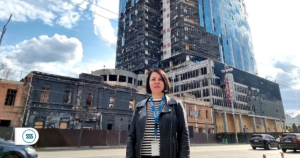
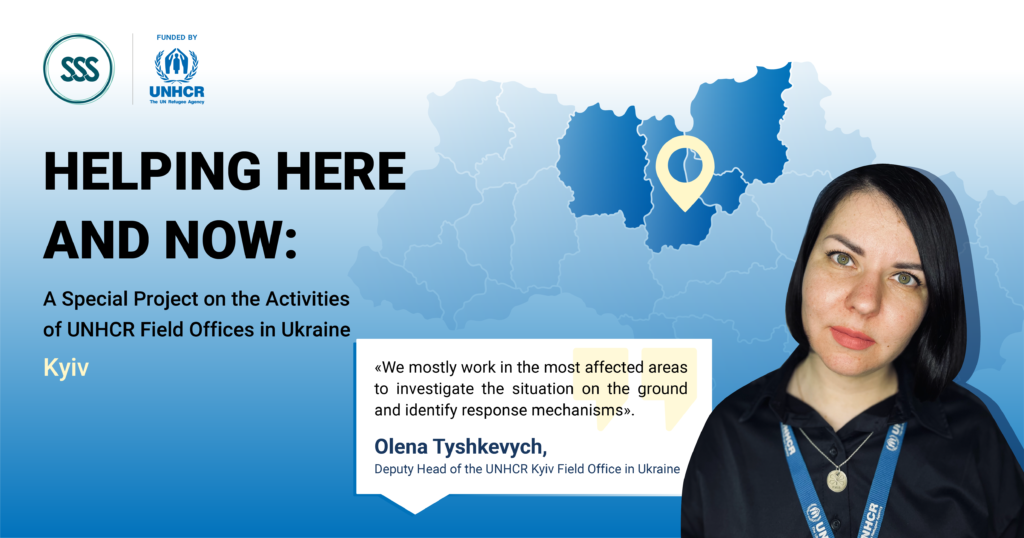
Our first interviewee is Olena Tyshkevych, Deputy Head of the Kyiv office of the UN Refugee Agency in Ukraine. This year, the office takes care of three oblasts, namely Kyivska, Chernihivska, and Zhytomyrska, which suffered extensive damage and destruction caused by the Russian Federation’s war against Ukraine. Our Foundation has been cooperating with the Kyiv Hub since June 2022. During this time, we have equipped 36 workplaces in the departments of social protection of the population (hereinafter referred to as the DoSPs) in Kyivska and Chernihivska oblasts. In December, we also handed over a 20 kW generator to the Department of Social Protection of the Boryspilskyi Raion Administration, five servers to the Departments of social protection of the Kyivska Oblast Military Administration, stationery kits to the Departments of social protection of the Kyivska and Chernihivska oblasts, as well as first aid kits.
On supporting the social protection system as a priority for UNHCR in Ukraine:
- The UN Refugee Agency does not only operate as an emergency response organization. We help to protect the rights of the people we work with: refugees, asylum seekers, stateless persons, internally displaced persons (IDPs), and people affected by armed conflict.
- Given the situation in the country, we are currently prioritizing the needs of the social protection system. The ongoing reform of the transfer of powers to social protection departments, access of IDPs of all waves, from 2014 to 2023, to living allowances, social benefits, and services for IDPs from vulnerable groups are the issues that are of the greatest concern to the people we help. We see the issues and focus our projects and programs on solving them by supporting the social sector. We help to create jobs for employees of the social security system, in particular in cooperation with our partner, the Charity Foundation Stabilization Support Services This allows institutions to process requests and provide social services more efficiently.
On the needs of DoSPs in the regions covered by the field office:
- In 2022, UNHCR’s Kyiv Field Office covered Kyivska and Chernihivska oblasts, and this year it also covers Zhytomyrska Oblast. Undoubtedly, the ongoing internal displacement in and between these regions (particularly in the case of Kyivska oblast) has significantly increased the workload of social departments. Compared to last year, we see positive changes, but unfortunately, challenges remain. Queues for IDP registration are small or non-existent. Social protection departments in Kyiv and Kyivska Oblast are gradually receiving new equipment, but they are still understaffed.
- As for Chernihivska Oblast, we are seeing problems with logistics. In communities close to the border, there is almost no transport connection, and social protection departments are located only in raion centers. People cannot reach them. When the pontoon crossing of the Desna River is closed, part of the oblast is cut off from the oblast center.
- In areas affected by active hostilities, we see extensive destruction and many looted institutions. Therefore, what was relevant last year remains our priority this year. We will continue to provide technical assistance, including laptops and workstations, to DoSPs.
- In addition, reform is underway to transfer powers over state benefit payments from social protection departments to Pension Fund offices. If it slows down, people may face delays in payments. Therefore, we are doing everything we can to help the departments optimize this process and submit the necessary documents to the Pension Fund authorities in a timely manner.
On the level of IDP integration into communities:
- When we talk to IDPs, we clearly see their intention to integrate into host communities. This is particularly evident among those who do not plan to return home in the observable future. IDPs’ priorities remain the same: housing and employment. If people have difficulties with these issues, they are more likely to move to other settlements or abroad.
On supporting social protection departments in 2023:
- In 2023, as was the case last year, through our partner Stabilization Support Services, we are helping to create new jobs in social protection departments by providing material and technical assistance. In addition, we strive to strengthen the capacity of the social protection system and enhance the knowledge of employees of the DoSPs: we plan seminars, webinars, and individual consultations on topics of their interest. We pay special attention to combating burnout. Stabilization Support Services will hold events (online and offline) on this crucial topic, as such skills are key in working with affected people.
On setting up UNHCR’s work in Ukraine:
- UNHCR builds its work in accordance with an area-based approach to integrated response within a geographically defined region, primarily working in locations with urgent humanitarian needs. When we have met them, according to the classic Maslow’s pyramid, we activate projects and programs that should benefit people in the long run. Our office is located in Kyiv, but we mostly work in the most affected areas to investigate the situation on the ground and identify response mechanisms. This ability to visit, see, and communicate on a regular basis makes it possible to ensure that no one is left without help in practice, not just on paper in the reports.
On the specifics of the Kyiv Field Office:
- The Kyiv field office has been operating in its current format since August 2022, when the core team was formed. The most interesting feature, in my opinion, which I have already mentioned, is that we are based in Kyiv, but we actually work in the regions and implement classical humanitarian programs. We distribute non-food items, help with repairs, and provide legal and psychosocial assistance.
- The painful consequences of the full-scale invasion, which, unfortunately, continue to this day, the location of the office and our everyday life in Kyiv mean that we live in two worlds. On the one hand, there is the city you love, which lives and breathes, where it is easy to forget about reality between air raid alarms. On the other hand, there are destroyed and half-destroyed, looted, but unbreakable villages that need our help. The opportunities and programs of our field office motivate us to work even harder, to help both people and the country in both the immediate and long-term perspective.
On losses and hopes: stories from Kyivska and Chernihivska oblasts:
- Our team hears many stories, and each of them is special. I want to share two cases that happened in 2022. One story happened in the Kyivska Oblast, in a village in the Buchanskyi Raion. A large family ran the only grocery store in the village, which operated out of their home. Unfortunately, the house was severely damaged during a shelling. The family spent all their efforts looking for help with the repairs because they wanted to stay in their home, on their land, with their fellow villagers. Thanks to our light and medium repairs program, we were able to help them restore the roof, doors, windows, and the supporting wall. The house is now habitable, and the family is back to doing what they love. The store reopened its doors to its customers.
- The story that happened in the Chernihivska Oblast is much more tragic. The family, which included an elderly man with disabilities, was able to leave the danger zone. But since there were eight people in the family, they evacuated in two stages. During the first wave, the elderly man stayed at home and, unfortunately, didn’t get to see the second wave. A shell hit the house, and the man died before his family could take him away. The modular house we provided will certainly never compensate for this painful loss. But this assistance allows the family to stay in the community and gradually rebuild their home.
On the cooperation of the Field Office with CF Stabilization Support Services within the framework of the project “Supporting the Capacity of the Social Protection System to Register Internally Displaced Persons”:
- We have known our colleagues from Stabilization Support Services for a long time and are happy to work together. The primary goals of cooperation in our regions are to rebuild and increase the capacity of the social protection system and help it respond to the largest internal displacement in Ukraine’s history. Institutions still have to overcome the consequences of the full-scale invasion: workload, staff turnover, destruction and looting of institutions, and search for new premises and equipment. There are millions of heartbreaking stories that social workers hear from IDPs from all over Ukraine.
- Of course, neither we nor our partners can stand aside. We see a long-term perspective in what we can do now, such as providing technical equipment, including laptops, and training. One day, funding for humanitarian projects will be reduced, and it will be the government that will meet the needs of the people we work with. Our task is to prepare government systems for this as much as possible.
This article was developed by the Charity Foundation Stabilization Support Services with funding from the United Nations Refugee Agency (UNHCR). The content presented in this publication is exclusively the responsibility of the CO CF SSS and should not be interpreted as representing the viewpoint of the Agency.