
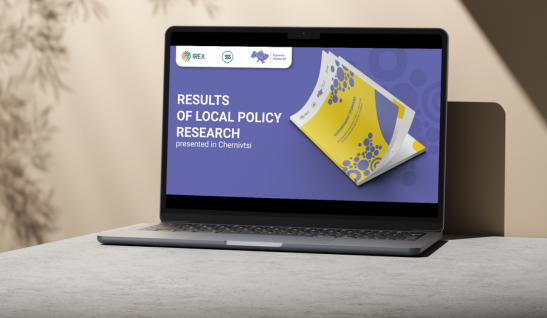
In Chernivtsi, experts of the United Voices in Action initiative, implemented by the international organization IREX in partnership with the Charity Foundation Stabilization Support Services and backed by the U.S. Department of State, presented a large-scale study of local policies and programs. This study casts light on how IDPs’ rights are respected and their integration into the life of their new communities.
The legal experts involved meticulously examined 193 local legislative enactments from 25 communities across 15 oblasts in Ukraine, including Chernivetska Oblast. It has been established that due to ambiguous definition of “permanent residence”, IDPs lack the ability to participate in local decision-making and receive certain kinds of social benefits. This was explained by Mykola Dubets, the regional coordinator of the United Voices in Action program in Chernivetska Oblast.
“The majority of statutes don’t consider IDPs as part of the local community. This means they’re excluded from specialized programs meant for local community members, leading to a form of discriminationю There are certain restrictions on participation in community life. IDPs are barred from general assemblies, public consultations, voting on participatory budget projects, and using other instruments of local democracy,” said Mr. Dubets.
However, according to Mr. Dubets, there have already been some positive developments. The Coordination Council for Internally Displaced Persons under the Executive Committee of the Chernivtsi City Council is considering the issue of including IDPs in the local program of social protection and social support.
“The authorities listen to our suggestions. For example, local authorities implement the decisions of the IDP Council. The chairman of the coordination council is the deputy mayor, and he helps us resolve issues. Experts from various fields are invited to participate in the meetings. For example, representatives of the Department of Education and the Department of Transportation joined the discussion of free transportation for IDP children. When it came to the matter of populating the modular town, the municipal property department was involved,” said Mr. Dubets.
Mariya Stiopina, head of the IDPs’ work organization unit of the Social Policy Department of the Chernivtsi City Council, also spoke about benefits for IDPs.
“Today, there are certain changes in the implementation of IDPs’ rights in the social domain. The working group is currently developing an update of the Zakhyst social program. The matter of free public transportation for internally displaced children has been resolved. IDPs who do not live in the Chernivtsi community but are visiting local social institutions or for medical treatment can also use public transportation free of charge. There are certain gaps in our programs, but we are doing everything to eliminate them,” said Maria Stepina.
IDPs are involved in community life through the Coordination Council for Internally Displaced Persons. However, this does not mean that IDPs are directly involved in local decision-making, as the community statute needs to be amended to allow for this.
“All citizens of Ukraine, even if they temporarily live in our city and oblast, should enjoy all the rights provided by law. I would also like IDPs to cooperate more with communities. If IDPs do not report their problems or needs, local authorities will not be able to resolve these issues on their own,” summarized Mr. Dubets.
The experts developed recommendations for local authorities to improve their policies and programs to ensure that they take into account the interests and rights of IDPs. In particular, the experts propose to amend the community statutes and local targeted programs and regulations that define the procedure for providing benefits and assistance to certain categories of people.
Beyond Chernivetska Oblast, these findings will be presented in the 14 other studied oblasts. The United Voices in Action program will send a summary of the recommendations to the Ministry of Reintegration of Temporarily Occupied Territories and other relevant national and local authorities.
This activity was made possible as part of the United Voices in Action program, implemented by the international organization IREX together with the Charitable Organization “Charity Foundation “Stabilization Support Services” and with the support of the U.S. Department of State.