
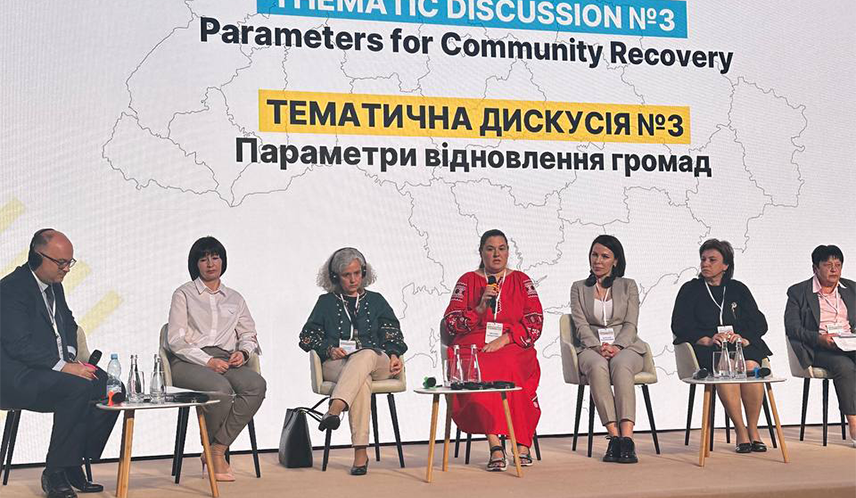
On May 10, Kyiv hosted the Inclusive Community Recovery national forum, organized by the Government of Ukraine, the Government of Germany, and the United Nations. We also participated in the event. Valeriya Vershynina, Chairperson of the Board of Directors of the Foundation, spoke during the “Parameters of Community Recovery” thematic discussion.
Many communities in Ukraine have been affected by the war and are now making considerable efforts to rebuild. The forum provided a platform to highlight successful local recovery initiatives, share experiences, and forge new partnerships. The second focus of the event was to explore how to improve coordination and complementarity between humanitarian assistance and community recovery.
The event brought together more than 400 representatives of the government, communities, international, civil society and charitable organizations, academia, and businesses. The forum was addressed by Volker Oel, German Commissioner for Eastern Europe, Denise Brown, United Nations Resident Coordinator in Ukraine, Oleksandra Azarkhina, Deputy Minister for Restoration of Ukraine, and Jaco Cilliers, Resident Representative at the United Nations Development Programme.
The panelists, joined by Valeriya Vershynina, considered ways to identify parameters that can be used to boost community recovery. In addition, the panel discussed options for gradually phasing out humanitarian work to avoid abrupt changes and gaps in service delivery in communities. They also discussed data requirements for a successful response in the community recovery effort.
Valeriya explained how the Foundation conducts research on the needs of communities, supports them in updating their social passports, and helps them develop medium-term plans for the development of the social protection system on the ground:
“In the context of social protection, it is important to have verified information about the resources and needs of the community because awareness helps to overcome the consequences of the war and to recover efficiently.
Social passports allow us to understand the institutional environment and show the range of services and the socio-demographic situation in the community. This is the basic data for identifying resources and needs. Monitoring of social protection needs demonstrates which community needs are met and which are not and identifies key gaps and areas for the development of the social protection system. Medium-term plans for the development of the social protection system identify the changes needed to achieve the goal of community development and facilitate the planning of resources to implement these changes.
By conducting research and providing the necessary information to support humanitarian recovery, data actors can play an important role in identifying the needs of affected communities and addressing their problems. The CO CF SSS is ready to share its best practices in this area and experience in supporting communities throughout Ukraine.”
On June 11-12, the Ukraine Recovery Conference (URC) will be held in Berlin. The Forum in Kyiv supported communities to participate in the Map of Ukraine event during the URC.
We conduct research and help communities update their social passports as part of the Supporting the Capacity of the Social Protection System to Register Internally Displaced Persons project funded by the UN Refugee Agency in Ukraine.