
On August 25th, the scenic city of Kovel witnessed the culmination of the final phase of the car diagnostics course. In July, the course welcomed 20 students from various corners of Ukraine. Each one of them successfully graduated, securing their diplomas.
This phase notably included internally displaced persons and residents from cities affected by the war. Here are some inspiring stories of the participants who seized this chance to foster personal and professional growth.
Anna, Bohodukhiv — Lviv
Inside the Kovel training center, we encounter Anna, a displaced individual from Kharkivska Oblast.
“I hail from Bohodukhiv in the Kharkivska Oblast. Before the full-scale invasion, I had been serving as a soldier for five years and continued for almost another year after February 24, 2022. Returning home is daunting because of its proximity to the Russian border. Although I’m registered as an internally displaced person in a different city, I’ve chosen to rent a place in Lviv due to better adaptation prospects. My daughter is pursuing her studies online, and my husband, also a soldier, is stationed at the frontline in Donetska Oblast. I’m in the process of job-hunting in Lviv and checking available positions,” shares Anna.
She stumbled upon the car diagnostics course online.
“While browsing a group online, I came across these courses and decided to apply. Honestly, I was skeptical about my chances, assuming they might not entertain female participants. Yet, to my surprise, the very next day a representative from the foundation contacted me to confirm my interest. I’ve always been intrigued by the mechanics of things, especially when something’s being fixed, which is why I thought I’d give it a shot,” Anna elaborates.
For her, this course presents an opportunity to learn something new.
“The car diagnostics sessions are immensely informative, and I’m figuring out how to assimilate all that I’m learning. I appreciate that they encourage questions and clarify any doubts. Their teaching isn’t just a binary of ‘get it or don’t’, they patiently break things down for us,” she conveys, a hint of amusement evident in her expression.
Dmytro Stepanov, Zaporizhzhia — Kaniv
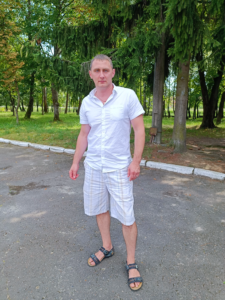 Dmytro Stepanov, originally from Zaporizhzhia, has since relocated to Kaniv in Cherkaska Oblast.
“After the full-scale war began, our home was on the outskirts of Zaporizhzhia, overlooking places like Mariupol, Vasylivka, and Huliaipole. I could discern events based on the noises alone,” Dmytro remembers the initial days of the full-scale invasion.
After the invasion, Dmytro along with his expectant wife and child shifted to his parents’ residence located on the right bank of Zaporizhzhia.
“Soon, we learned of evacuation trains departing from Zaporizhzhia. However, considering my wife was four months into her pregnancy, I was apprehensive about her using that route. Instead, she later journeyed with friends to the Czech Republic by car. When her delivery neared, she returned to Ukraine, realizing the challenges of managing alone with two kids. She was back in Zaporizhzhia by July 9, 2022, and welcomed our child on July 13,” Dmytro recounts.
In fall 2022, Zaporizhzhia witnessed missile attacks that targeted residential buildings.
“At that point, we decided to leave the city. We packed our car with whatever we could. Truthfully, we were uncertain about ever returning,” he reflects on that daunting experience.
Now settled in Kaniv, Dmytro pursued roles that matched his professional forte.
“My expertise does lie in cars, but in a slightly different area, not in engines but in supplemental gear. Initially, many car service centers didn’t see a fit for my skills. Often, locals would head to Kyiv or Cherkasy for the kind of specialized repairs that I can do. However, one service center proprietor did see potential in me and offered a position,” Dmytro narrates his employment journey.
Interestingly, it was his wife who introduced him to the car diagnostics course. “She asked if I’d be interested in attending. I expressed concerns about her managing our two kids alone, but she assured me she was able. The fact that the course, inclusive of food and lodging for IDPs, was free made it a viable choice without any added financial strain,” he shares.
Dmytro believes learning and expanding knowledge opens up new opportunities. “These courses are an opportunity for me to improve my skills,” he acknowledges.
Nataliya, Pokrovsk — Dnipropetrovska Oblast
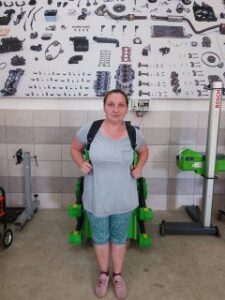 Nataliya and her son Mykhailo are IDPs from Pokrovsk, Donetska Oblast. They live with their 66-year-old grandmother. Nataliya is a single mother of two children aged 7 and 15.
“We saw the announcement about the car diagnostics course on the Internet. I applied for the course for myself and my eldest son. We both received a positive response. Mykhailo has finished 9th grade. We don’t know which school he will go to for the 10th and 11th grades and whether he will have time to finish it, but he will already have a profession. I am a plasterer by profession. I had a surgery in February this year. Now, due to my health and the situation in the country, I can’t practice my trade, so I decided to try something else,” Nataliya begins her story.
The relocation was a tough point in the family’s history.
“We left Pokrovsk in April last year when the Tochka U missiles started flying over the roofs,” Nataliya recalls.
It was then that Natalia made the difficult decision to move her family to a safer region.
At first, they lived in Verkhniodniprovsk in Dnipropetrovska Oblast, where local residents and volunteers provided tremendous support.
“We lived in a school, they gave us a whole classroom there. Everyone there was great: they brought us clothes and food,” Nataliya says.
She believes that the car diagnostics course is the first step in acquiring a new profession and plans to reinforce her knowledge by working at a service station.
“Where we live, there are many people who repair cars. We can arrange to continue gaining practical experience with them. The courses gave us basic knowledge, but we still need to practice to be more confident. If I had the opportunity to continue my studies, I would, because the instructors here are truly top-notch,” Nataliya says.
Andriy Shevchenko, Kharkiv
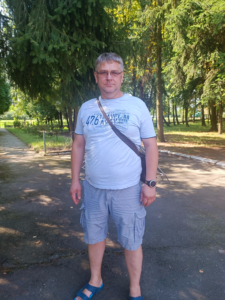 Andriy has been a car electrician since 2006. Over the years, he worked at various stations before realizing he preferred being self-employed. These courses offered him a chance to refresh and broaden his expertise.
“I didn’t arrive here as an IDP. My wife sent a letter, and upon receiving a response, I got support. Now, I independently repair cars in Kharkiv,” mentions Andriy Shevchenko.
When the full-scale invasion began, Andriy relocated his family to Chernivetska Oblast. However, he soon made his way back to his birthplace.
“My parents remained in Kharkiv. I returned primarily because my father suffered a second stroke. Upon my return, I resumed my independent work,” says Andriy, who is keen on broadening his professional horizons.
“I’m here since I realized my knowledge had gaps. With the advent of new generation vehicles in Ukraine and their nuanced systems, my existing knowledge felt inadequate. Although the fundamentals remain the same, I need more insight. The course here is comprehensive, and the instructors are seasoned experts who deliver thorough information,” Andriy adds.
The Foundation has granted him a platform to further his education and hone his skills.
“Admittedly, not all the insights sink in instantly. It takes time to assimilate them. Once I’m back, it’s crucial to apply what I’ve learned. Hands-on practice will solidify my knowledge,” Andriy asserts.
Anna Babenko, Horlivka — Kherson — Odesa
In 2014, when the war in Ukraine began, Anna and her family fled Horlivka for Kherson. They called it home for 8 years. Yet, in 2022, they decided to relocate once more, this time to Odesa.
They remained in Kherson throughout the entire period of the city’s occupation.
While Anna’s professional background is in fashion design, circumstances didn’t allow her to pursue her career. Feeling the urge for a fresh start, she enrolled in the car diagnostics course.
“I felt a strong desire for a dramatic change. I was keen on beginning something personal. I’m open to any challenge and intrigued by stepping out of my comfort zone. It’s all part of growing, and I’m embracing it,” Anna expresses.
During her car diagnostics training, Anna grappled with unfamiliar terms and concepts. Nevertheless, she persevered and completed the course. She’s eager to tap into the opportunities within the car repair sector.
“In terms of job prospects in Odesa, I’ve yet to explore. I intend to seek avenues to get hands-on experience. Fortunately, there’s a workshop close to where I live. I aim to approach them to gauge interest. I’m optimistic about my plans falling into place!” Anna outlines her aspirations.
On the possibility of returning to Kherson, she reflects, “It’s challenging to predict the future or make extended plans. I prefer to stay grounded in the present, as the future remains uncertain. Living in the moment and cherishing each day is paramount to me.”
Kostiantyn, Mariupol — Kharkiv
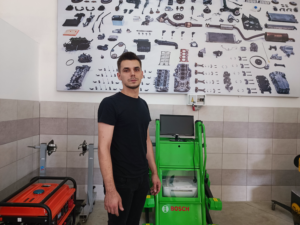 Kostiantyn hails from Mariupol. However, the 2014 events in eastern Ukraine compelled his family to leave their birthplace.
Relocating to Kyiv with his mother and brothers, Kostiantyn left his father behind in Mariupol. His parents had parted ways by then. After completing school in Kyiv, a job opportunity led his mother to Kharkiv.
“I pursued my education at Kharkiv National University,” he recalls. “My major was multifaceted, encompassing aspects like engines, vehicle architecture, materials in car manufacturing, and vehicular processes including thermodynamics and hydraulics. I’ve been employed in my field since my junior year in college.”
On February 24, 2022, Kostiantyn found himself in Kharkiv. Given his history with Mariupol, where explosions were commonplace post-2014, the blasts in Kharkiv didn’t instantly strike him as menacing. “I spent the initial days indoors with my girlfriend and her family. My workplace announced a temporary shutdown.”
“A week into it, I began ferrying acquaintances to the railway station, assisting those unable to leave independently. Soon, a former classmate and current colleague proposed a joint volunteering effort. And that’s how I started volunteering, and we still do, we have our own small foundation.”
Their initial mission entailed distributing humanitarian aid to residents in zones of hostilities, at one point assisting 8,000 families. When Kharkivska Oblast was de-occupied, the foundation’s assistance scaled down, focusing primarily on urgent needs.
In early March, Kostiantyn lost conact with his Mariupol-based relatives.
“For an extended period, I lost contact with my Mariupol relatives. I last conversed with them on March 2, albeit amid disruptions. In early June, distressing news reached me via my uncle — my father had passed away. They managed to find and bury him. This news hit hard, because my work was strongly connected with my father. Our interactions were more professional than paternal. I even contemplated abandoning the field,” shares a somber Kostiantyn.
For a while, he steered clear of automotive work, pouring his energy into volunteerism. Eventually, a friend mooted the idea of starting their own car repair enterprise. “Currently, my friend and I are partners. It’s intriguing to ponder how it would have panned out in peaceful times. Business is thriving, and we’re steadily establishing our clientele and expertise.”
Stationed at Kostiantyn’s workshop is the oscilloscope — an essential tool taught in car diagnostics courses.
“It’s a game-changing tool in car diagnostics. With it, dismantling an entire engine becomes unnecessary to pinpoint a malfunctioning component. My introduction to car diagnostics was under my father’s tutelage. He’d constantly stress its importance, as he wasn’t taught to use it. He lacked this equipment but was still a proficient diagnostician. Perhaps he recognized the tool’s potential. He’d often remind me, ‘I aim to equip you with basic knowledge. Your task is to master diagnosing any system, comprehending it from the chemical reactions to the full picture.’ The oscilloscope is that pivotal device, enabling intricate diagnostics. Training courses equip you with the essential groundwork, a springboard for future proficiency.”
Yuriy Pastukhov, Luhansk — Bucha — Smila
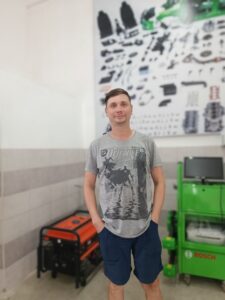 Yuriy, a native of Luhansk, relocated from his birthplace in 2004. His journey led him first to Kyiv and later to Crimea, where he lived from 2008 to 2014. The events of 2014, however, necessitated another move.
At the beginning of the full-scale invasion, Yuriy was living in Bucha, juggling roles as an electronics repairer and a diesel station worker.
“My residence was a mere 2 km from Hostomel. Just prior to the invasion, I contracted COVID-19,” Yuriy recalls. “On the morning of February 24th, my landlady alerted me, exclaiming, ‘Yura, it’s war!’. At that point, the virus had sapped my energy to even stand. Amidst the chaos, we were fortunate to retain water, electricity, and communication. Days later, I witnessed the ATB supermarket burst into flames. As food supplies dwindled, residents scoured the city for sustenance. I subsisted on sweets and pumpkin seeds for about four days. Once, while biking home to feed my cat, shells began raining down around us.”
Yuriy’s immediate response was to grab his feline companion and passport, and pedal his way through the woods to Kyiv. Once in the capital, he began volunteering, delivering essential medications to senior citizens using his bicycle.
“I volunteered in Kyiv for a month, benefiting from free accommodation. Subsequently, I joined my family in Smila. Given the job scarcity in Smila, I took on roles as a handyman, tending to minor household tasks. I kept tabs on the foundation’s updates and was drawn to their course offerings. Post-training, I aim to pivot career-wise. I’ve friends in service stations, which is a plus. Regardless of the scenario, taking that first step is vital. Even if one lacks the tools, action is key,” Yuriy reflects.
The project “Car Diagnostics Courses” is implemented by the “Stabilization Support Services” Charity Foundation with the support of the humanitarian organization Сhoose Love.