
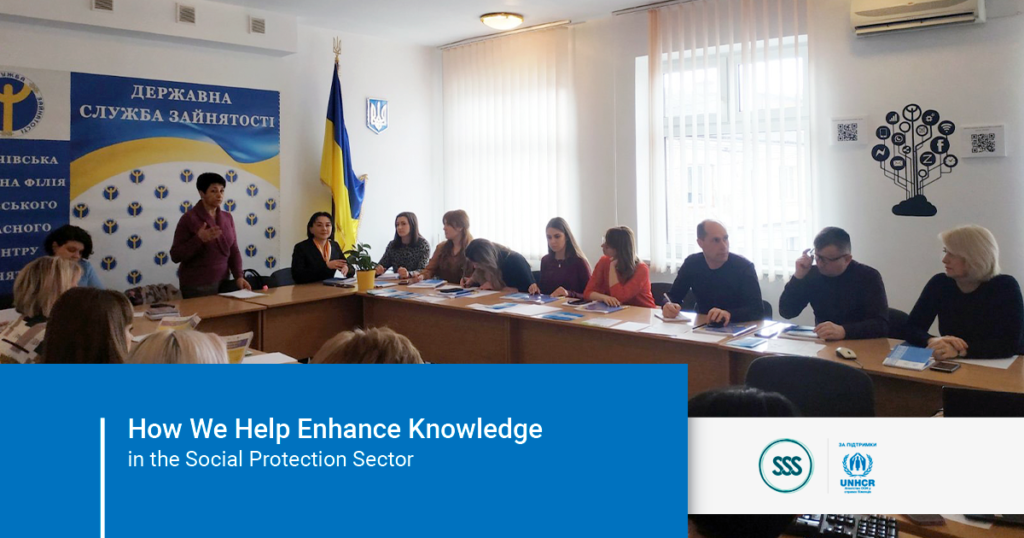
Social security legislation is constantly changing, and we strive to help you to be aware of the most important changes. During March, we held 22 training meetings in 15 oblasts for employees of the social protection system, as well as for displaced persons.
We organized 13 trainings for representatives of the social security system in the target communities to improve their knowledge of working with IDPs. In particular, with the participation of the project’s regional lawyers, the following issues were analyzed:
- registration of IDPs and grounds for cancellation of the registration certificate;
- provision of accommodation assistance to IDPs and reasons for refusal of assistance;
- compensation for destroyed/damaged housing in accordance with bill No. 7198.
Halyna Senyk, the deputy director of the Social Policy Department of the Ivano-Frankivska Oblast State Administration, the head of a Social Protection Department, says: “We all understand the need for timely registration of IDPs. Last year, our oblast was one of the first to introduce temporary certificates for the registration of IDPs. This made it possible to properly respond to the social and humanitarian needs of people who were forced to leave their homes. The government is now taking all necessary measures to improve the mechanism of IDP registration and the protection of their rights. Therefore, such educational activities are very important. During them, we can discuss problematic issues and learn new useful information for working with displaced persons.”
Tomoko Ishihara, a representative of the UNHCR, also joined the webinar in the Ivano-Frankivska Oblast. “One of the areas of work of the UN Refugee Agency is the support of state institutions, such as social protection departments. Registration of IDPs is an extremely important process, as it enables displaced persons to access social services and financial assistance. We are now developing long-term solutions to assist IDPs, including integration into communities or, if safe, returning home,” Ms. Tomoko said.
In addition to theoretical issues, the trainings covered practical cases. For example, a webinar in the Luhanska Oblast discussed the issue of providing assistance to IDPs who have moved from active combat zones to areas that are safer but temporarily outside the control of the Ukrainian government. At the meeting in the Chernihivska Oblast, the participants discussed the problem of medical and social assessment during martial law and possible ways to solve it.
Two trainings for social workers and employees were dedicated to an equally pressing topic: combating professional burnout.
We also held 9 meetings for IDPs and people affected by the war of the Russian Federation against Ukraine, during which we informed the affected people about their rights. Regional teams presented our project to support the social protection system and its opportunities for IDPs. Among others, the meeting participants discussed the following issues:
- registration and receipt of financial assistance for IDPs, in particular, the assignment of assistance to displaced children;
- accessible social services and protection of the rights of IDPs;
- adaptation in a new place and integration into the community.
In March, we organized 11 trainings on creating and updating social passports in the target communities of 5 oblasts. For more information on the functions of this document, please visit our website at: https://bit.ly/3KkHm3l.
We will continue to hold educational meetings to share relevant and useful information. We implement these initiatives within the framework of the project “Supporting the Capacity of the Social Protection System to Register Internally Displaced Persons,” funded by the UN Refugee Agency in Ukraine.