
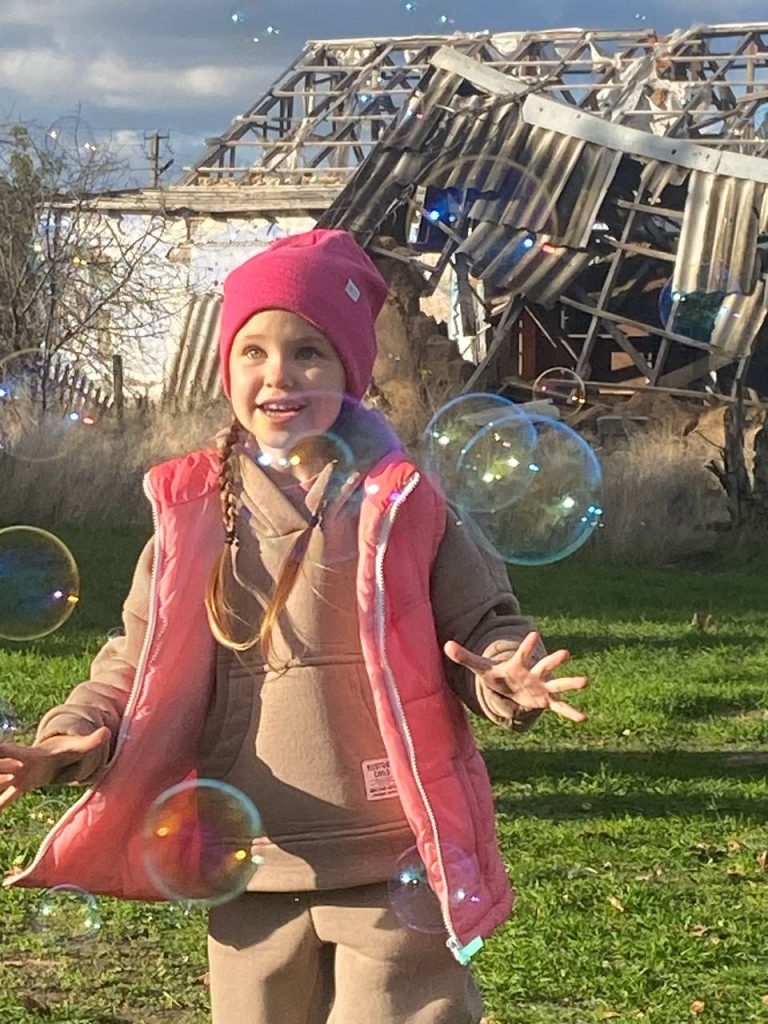
When the full-scale war began, Kateryna from the village of Partyzanske in the Mykolaiv region was only a year and a half old. For almost a month, the girl lived in a basement with her parents, brother, and sister. When her fellow villagers began to leave en masse, Kateryna’s family also decided not to take any more risks.
“We just drove off at random and ended up in a small village in our region, where a family we didn’t know took us in. We lived with them for almost a year, until Snihurivka, a village near ours, was liberated,” recalls Kateryna’s mother, Olha.
When she returned home and saw her native village, she could not believe her eyes: deserted streets, completely destroyed houses, and ruined infrastructure. According to her, it seemed then that life here would never return, but today, in the still unrebuilt Partyzanske, you can hear children’s laughter again. Kateryna is already five years old, but she has never been to kindergarten as it was destroyed, just like the school.
“Kateryna attends kindergarten online: twice a week, the teacher talks to the children on the phone for 15 minutes and gives them easy tasks. But that’s not enough, because our daughter is very smart, cheerful, friendly, and sociable, and she lacks real-life socialization with other children. And there’s nowhere for them to get together — there isn’t a single playground in the village,” says the girl’s mother.
The Self-Help Workshop psychological training for children from frontline areas, organized by our foundation as part of the Lifesaving: Protection, Shelter, and WASH for War-Affected Regions project was a true celebration for Kateryna and her friends. Tetiana Nomyrovska, a psychologist with the mobile team in the Mykolaiv region, recalls this meeting with particular warmth:
“The children greeted us with great joy. Within five minutes, they were already actively communicating with us. We made various children’s crafts and played games that help release inner tension and restore trust and a sense of security. And when we connected the soap bubble machine, there was a real explosion of happy emotions, because some of the children were seeing this for the first time. This really touched our whole team: children who had experienced the horrors of war had not lost their ability to enjoy simple things…”.
The visits of psychologists and organizations that conduct classes for children are very important, says Kateryna’s mother. In frontline communities, this is a unique opportunity for children to socialize, have fun, and simply connect with others.
“Kateryna still remembers the training session conducted by your Foundation’s team. She often asks when she can participate again and eagerly awaits similar events in the village. It is difficult for me to realize what our children are going through right now: their childhood has been stolen from them. So, thank you very much to your Foundation for giving our children happy moments in these difficult times,” Olha concludes gratefully.
The project is implemented by the Charitable Foundation “Stabilization Support Services” in partnership with the Malteser International charity organization and with the support of Aktion Deutschland Hilft.