
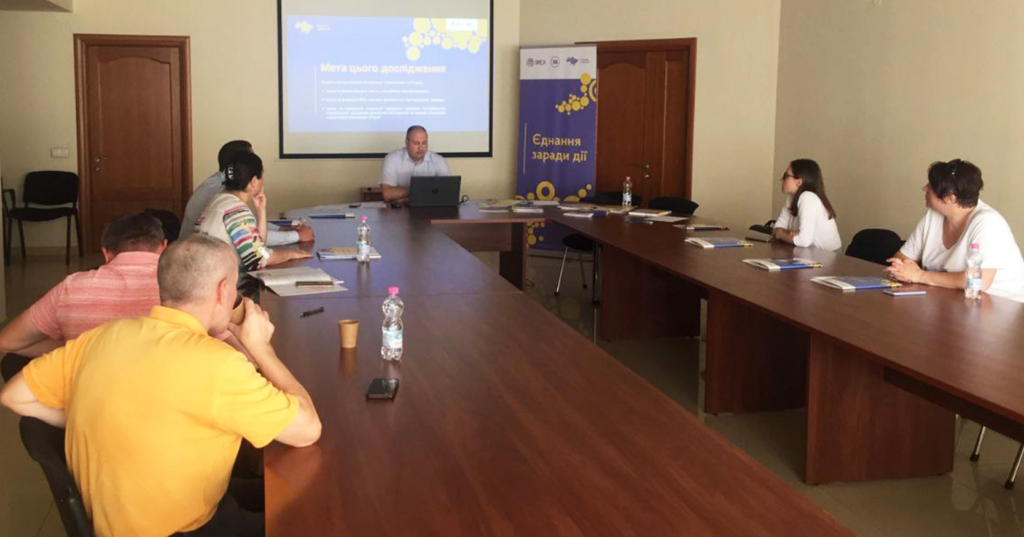
In Ivano-Frankivsk, experts of the United Voices in Action initiative, implemented by the international organization IREX in partnership with the Charity Foundation Stabilization Support Services and backed by the U.S. Department of State, presented a large-scale study of local policies and programs. This study casts light on how IDPs’ rights are respected and their integration into the life of their new communities.
The legal experts involved meticulously examined 193 local legislative enactments from 25 communities across 15 oblasts in Ukraine. In particular, in Ivano-Frankivska Oblast, experts examined the situation in two communities, Ivano-Frankivska and Kolomyiska. In the former community, the experts analyzed eight regulations, and four more documents were scrutinized in the latter community. It has been established that due to ambiguous definitions of “permanent residence” and “place of residence registration“, IDPs lack the ability to participate in local decision-making and receive certain kinds of social benefits. They often can’t engage in local decision-making or access certain social benefits. This was explained by Vitaliy Svitlyk, the regional coordinator of the United Voices in Action program in Ivano-Frankivska Oblast.
“We found that 125 out of 193 regulations out of the 193 examined did not meet the requirements for unimpeded access to various policies and programs that would allow IDPs to enjoy travel or food benefits, sign electronic petitions, vote for local initiatives, etc. That is, to participate in community life and receive social support on an equal footing with other community members,” said Vitaliy Svitlyk.
Yevheniya Bardiak, a member of the Ivano-Frankivska Oblast Council, explained that internally displaced persons often seek medical treatment, but current programs do not provide for this without registration in the community. This needs to be changed.
“I have many examples of IDPs asking for funds for treatment. However, it is impossible to satisfy these requests within the framework of existing programs because IDPs are not included in the list of categories of citizens who can receive such assistance. This is a very telling example that the programs need to be changed,” said Bardiak.
The researchers also found successful practices. For example, in both communities, IDP children receive free meals in kindergartens and schools. In Kolomyia, the program “Providing Support to Internally Displaced and/or Evacuated Persons for 2023” was approved, which provides for repairs and equipment of places of temporary residence for IDPs.
Ihor Ivakhniuk, Deputy Head of the Social Policy Department of the Kolomyia City Council, told more about the program:
“Funds are allocated for the construction of shelters for temporary and medium-term accommodation of IDPs. Kolomyia is one of the first communities in Ukraine to allocate municipally owned premises to house IDPs. Currently, there are four such shelters with up to 250 people living there,” said Ivakhniuk.
In addition, IDP Councils are being established under local authorities to help IDPs integrate, have their voices heard, and influence the affairs of their communities. In the Kolomyiska community, the IDP Council is already in operation, and in the Ivano-Frankivska community, it is still undergoing the process of establishment.
According to Yevheniya Bardiak, each community should respond to the needs of IDPs independently and make changes to local policies and programs or create new ones:
“These should be programs that provide a range of assistance to IDPs. It is not only about medical treatment but also about support in acquiring social housing and priority in enrolling children in educational institutions. Perhaps it will include support in starting or running a business.”
Therefore, the researchers formulated recommendations for local authorities to improve policies and programs to ensure that they take into account the interests and rights of IDPs.
“We don’t just say what is wrong. We provide recommendations to local authorities. This way, they can fix the gaps that contradict the law and do their best to help IDPs integrate and be included in community life,” explains Vitaliy Svitlyk.
In particular, the experts propose to amend the community statutes and local targeted programs and regulations that define the procedure for providing benefits and assistance to certain categories of people.
Beyond Ivano-Frankivska Oblast, these findings will be presented in the 14 other studied oblasts. The United Voices in Action program will send a summary of the recommendations to the Ministry of Reintegration of Temporarily Occupied Territories and other relevant national and local authorities.
This activity was made possible as part of the United Voices in Action program, implemented by the international organization IREX together with the Charitable Organization “Charity Foundation “Stabilization Support Services” and with the support of the U.S. Department of State.