
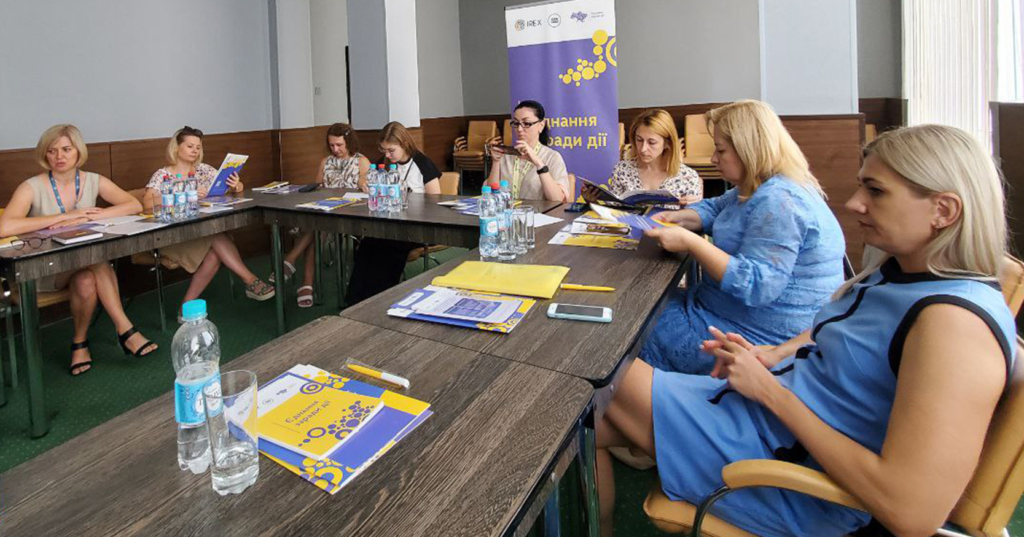
In Lutsk, experts of the United Voices in Action initiative, implemented by the international organization IREX in partnership with the Charity Foundation Stabilization Support Services and backed by the U.S. Department of State, presented a large-scale study of local policies and programs. This study casts light on how IDPs’ rights are respected and their integration into the life of their new communities.
The legal experts involved meticulously examined 193 local legislative enactments from 25 communities across 15 oblasts in Ukraine, including Volynska Oblast. The research was conducted in several stages. The experts analyzed documents published on official websites and responses to inquiries and then conducted expert interviews with local authorities.
It has been established that due to ambiguous definitions of “territorial community member” and “permanent residence”, IDPs lack the ability to participate in local decision-making and receive certain kinds of social benefits. They often can’t engage in local decision-making or access certain social benefits. This was explained by Iryna Pylypenko, the regional coordinator of the United Voices in Action program in Volynska Oblast.
“According to the statute of the territorial community of Lutsk, residents are recognized as persons who permanently reside in the city and are registered with the relevant authorities. Therefore, in order for IDPs to exercise their right to participate in local decision-making, the statute needs to be amended,” noted Iryna Pylypenko.
Local regulations governing the provision of benefits and assistance also need to be changed. Sometimes, IDPs cannot receive these due to the provisions of some of the programs.
“Together, we have to do even more to ensure that IDPs who have moved to the community feel like full-fledged members and have access to all the benefits that are available to local residents,” added the regional coordinator of the United Voices in Action program in Volynska Oblast.
Researchers have also come across successful practices. For example, the social benefits program for children in Lutsk provides assistance to both local and IDPs. This includes children of servicemen, military volunteers, and civilian volunteers who were killed or went missing. Internally displaced children receive free meals at schools and a 30 percent discount on meals in kindergartens. IDPs can also receive free psychological assistance, said Lina Halan, head of the Department of Social Services for Family, Children and Youth of Lutsk City Council.
“In this difficult time, we must unite and move forward. We have set up a counseling hub to help people recover from stress. We gathered the best experts in the city. We also had a lot of children come to us with their parents. We created an interactive room for kids. Our teachers helped a lot. The next step is to create mobile teams of social and psychological assistance,” emphasized Lina Halan.
Representatives of the civil society sector also emphasized that IDPs need support for adaptation and integration in a new place.
“In 2014, we started working with IDPs when we were accommodating them in Kharkiv region. At that time, many people from Luhanska Oblast relocated to us. We tried to hear them, understand them, and support them. Now I have become an IDP myself and have experienced all the difficulties that IDPs have to overcome,” said Iryna Rozhanska, coordinator of the SpivDiya Za Ditey project in Lutsk.
At the end of the meeting, the researchers formulated recommendations for local authorities to improve policies and programs to ensure that they take into account the interests and rights of IDPs.
“We have gathered this event not to criticize and complain, but to develop a common strategy for the successful integration of IDPs into the host community,” summarized Iryna Pylypenko.
In particular, the experts propose to amend the community statutes and local targeted programs and regulations that define the procedure for providing benefits and assistance to certain categories of people.
Beyond Volynska Oblast, these findings will be presented in the 14 other studied oblasts. The United Voices in Action program will send a summary of the recommendations to the Ministry of Reintegration of Temporarily Occupied Territories and other relevant national and local authorities.
This activity was made possible as part of the United Voices in Action program, implemented by the international organization IREX together with the Charitable Organization “Charity Foundation “Stabilization Support Services” and with the support of the U.S. Department of State.