
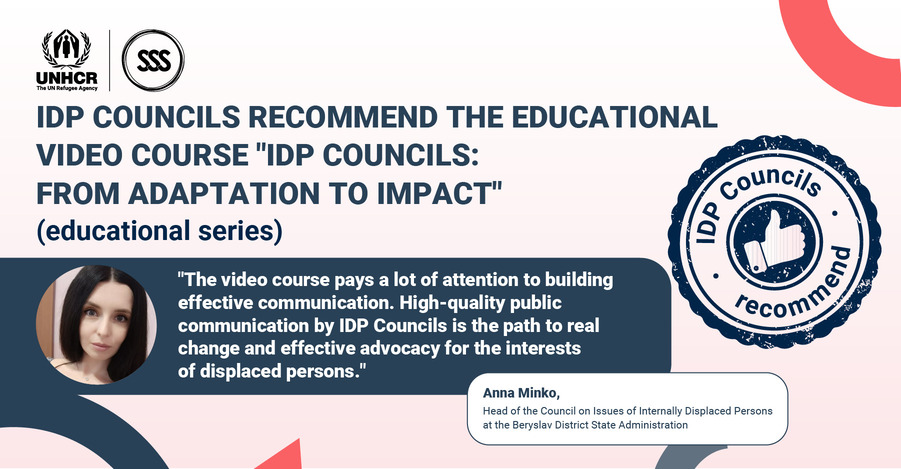
Our training video course, “IDP Councils: From Adaptation to Impact,” is a step-by-step guide for those who want to strengthen their Council’s efforts and better represent the interests of internally displaced persons in their communities. More than 700 people have already successfully completed the course and received certificates.
We continue to introduce you to the feedback of those who have completed the training. Anna Minko, head of the IDP Council under the Beryslavskyi Raion State Administration, shares her impressions.
“The training video course is useful for both new and experienced councils. It provides not only knowledge but also practical advice on what can be changed or improved in their work. A lot of attention is paid to building effective communication with the public and government bodies, and establishing cooperation with partners.
Series five, on strategic planning, and series six, on communication, were especially useful for me. High-quality public communication by IDP Councils is the path to real change and effective advocacy for the interests of IDPs.
This video course will be useful not only for members of the Councils but also for displaced persons in general. After all, it demonstrates that every person can become part of a team of change-makers and influence decision-making in the community. The course material is presented in a simple and clear way. The training is conducted online, which is very convenient, especially when combining volunteer activities with work. It’s about knowledge that inspires and provides practical tools for daily work.”
Want to help IDP Councils work more effectively and solve the problems of displaced people through effective local programs? Study with us — watch the training video course “IDP Councils: From Adaptation to Impact” on the Diia.Education platform. Everyone who completes the video course, passes the tests, and receives a certificate will be awarded 0.1 ECTS credit.
ECTS, or the European Credit Transfer and Accumulation System, is a tool developed by the EU to ensure the compatibility of higher education systems in different countries.
This publication was made with the support of UNHCR, the UN Refugee Agency in Ukraine. The content of the publication is the sole responsibility of the Charitable Organization “Charity Foundation “Stabilization Support Services” and does not reflect the views of UNHCR.