
CF “Stabilization Support Services” presented Ukraine’s hands-on experience in developing social services, social planning, and involving IDP Councils in recovery efforts in Germany.
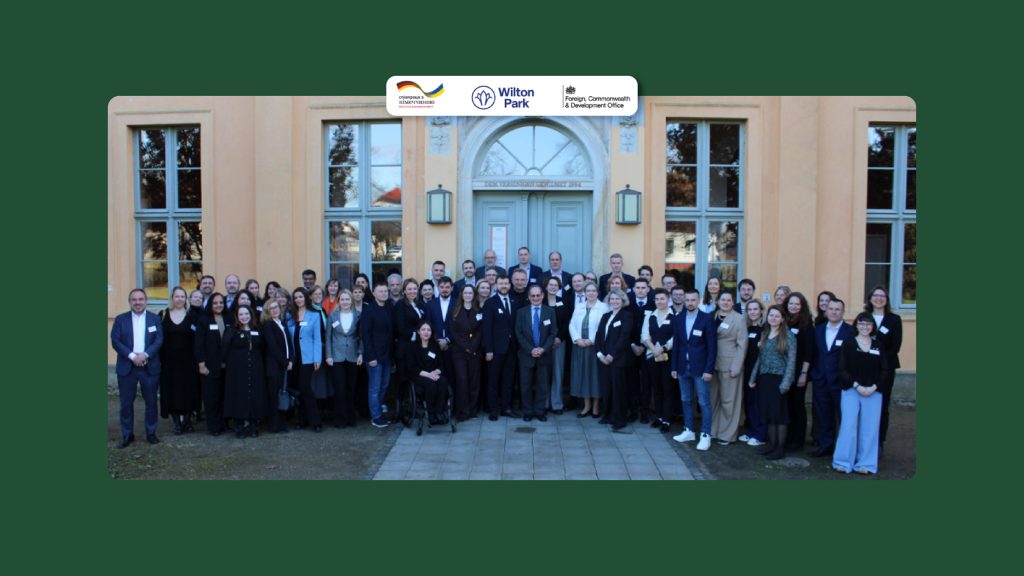
The international conference “Reform Priorities for Inclusive Social Recovery in Ukraine” was held in Germany on March 17–19, 2026. During the event, Valeriia Vershynina, Executive Director of the Charity Foundation “Stabilization Support Services,” presented Ukrainian practical experience in developing social services, conducting community needs assessments, social planning, and involving IDP Councils in recovery processes.
The conference brought together over 60 representatives from the governments of Ukraine and EU partner countries, international institutions, members of civil society organizations, and the expert, academic, and business communities. The discussion centered on a shared vision for Ukraine’s social recovery — one that is effective, sustainable, and people-centered.
Within the thematic group dedicated to access to social services at the local level, Valeriia Vershynina emphasized the role of communities as key participants in the support system. It is at the community level where it is most evident which services people truly need, which solutions work, and which remain only on paper.
During the discussion, she proposed recommendations for updating approaches to community needs assessment. This serves as the foundation for developing social passports and preparing medium-term social development programs and local social protection programs. Special attention was paid to data updating and utilization. Without it, communities cannot make informed decisions in the social protection sector.
The issue is not limited to demographics. High-quality planning requires a broader range of information: the accessibility of social services, the needs of various population groups, local risks, the consequences of displacement, and the changes occurring within communities during the processes of war and recovery.
Furthermore, Valeriia Vershynina stressed the need to systematically involve IDP Councils in discussions of local recovery projects and programs. Without the participation of people who have experienced displacement, it is impossible to speak of fully integrating the needs of IDPs into local policy and planning.
Practical examples presented during the discussion included: the creation of municipal social service providers in the communities of Mykolaivska Oblast, the launch of an early intervention service in Odeska Oblast, and the implementation of a “social taxi” in Uzhhorod. These cases demonstrate that even under wartime conditions, it is possible to develop effective social services in Ukraine when the authorities, communities, and the civil society sector coordinate.
During the event, Valeriia Vershynina also called on participants to support the declaration of intent “Sustainable and Quality Reconstruction: Participation of Councils of Internally Displaced Persons in Recovery Processes,” No. GRF-13096, aimed at strengthening the role of IDP Councils in planning, recovery, and decision-making at the local level.
Over the three days of the international conference, participants prepared practical recommendations for developing social policy, reforming the social protection system, enhancing the role of communities, and strengthening social cohesion. It is expected that these developments will inform policy shaping and coordinate actions in 2026.
The conference was organized in partnership with the Federal Ministry for Economic Cooperation and Development of Germany (BMZ) and the United Kingdom’s Foreign, Commonwealth & Development Office (FCDO).