
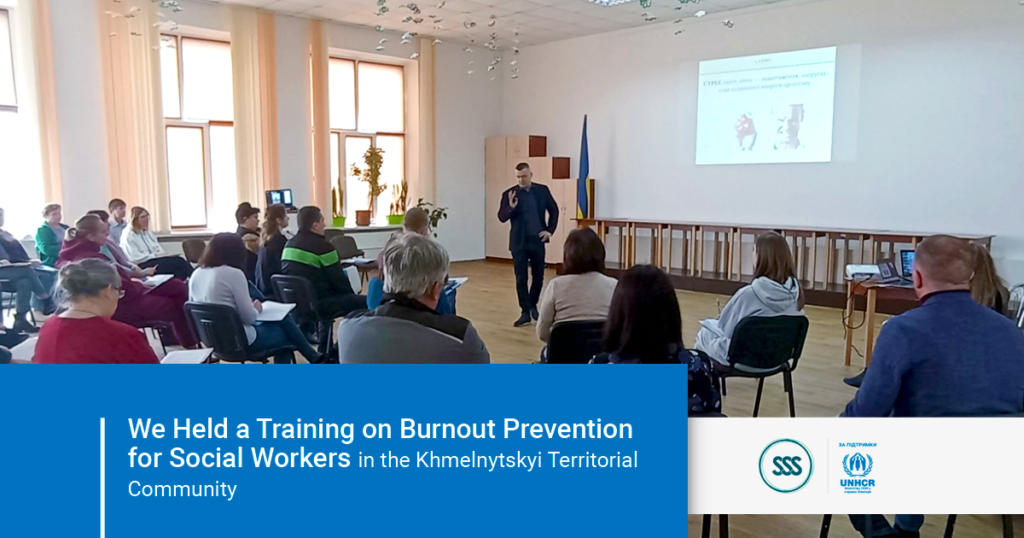
Participants of the “Combating Burnout for Social Workers” training, which was conducted on March 24 in the Khmelnytskyi territorial community, discussed various psychological health issues related to work burnout and stress management in people-oriented professions. Some of the topics included were how to prevent burnout at work, ways to build stress resistance when working with people, and determining when it’s necessary to seek the help of a psychologist. The training aimed to provide practical tools and strategies to help social workers manage their workload and maintain their well-being while providing care and support to others.
This event was organized as part of the project titled “Supporting the Capacity of the Social Protection System to Register Internally Displaced Persons”, implemented with the support of the UN Refugee Agency in Ukraine.
The goal of the event was to examine the needs and mental wellbeing of workers in the social sector and other establishments responsible for IDP registration. The diagnostic process will employ various tests, and the goal is to equip participants with practical methods for delivering psychological support in situations of stress and professional exhaustion.
The training was conducted by psychologist Serhiy Yefremov, an internally displaced person from Kharkiv. The event was attended by 30 representatives of social protection institutions in Khmelnytskyi. Also, Ms. Akiko Tsujisawa and Mr. Volodymyr Tsololo from the Vinnytsia office of the UN Refugee Agency joined the event online.
Nataliya Savytska, the regional coordinator of the project in the Khmelnytska Oblast, noted, “The Khmelnytska Oblast is among the regions that have received the largest number of internally displaced persons. Currently, approximately 140,000 IDPs are living in the Khmelnytska Oblast, and approximately 40,000 in the Khmelnytskyi territorial community. The entire burden of accommodating, providing information, and supporting IDPs is put on the shoulders of social protection workers. Therefore, we can understand the enormous stress they have experienced. It is extremely important to take measures to address burnout. Employees of the Khmelnytskyi territorial community are grateful for this training and asked to hold such events on a regular basis.”
Serhiy Yefremov spoke about the symptoms of stress and professional burnout, the consequences of that kind of exhaustion, and shared techniques for managing stress. During the training, all participants took tests to determine their level of stress resistance and completed exercises that help develop this skill.
The psychologist provided basic recommendations on how to prevent professional burnout syndrome:
- Always be aware of your mental state;
- Engage in relaxation exercises;
- See a counselor on a regular basis if necessary.
This guidance can prove beneficial not just to individuals working in the social protection sector, but also to anyone experiencing stress and seeking to regain a sense of normalcy in their daily lives.