
The second year of full-scale hostilities is a year of proactive self-advancement, a year marked by incessant change and adaptation. It appears that no corners of Ukraine remain untouched by the impact of these conflicts and the resulting aftermath. In such circumstances, Internally Displaced Persons (IDPs) transform from individuals seeking aid and integration into new communities into agents of positive change and development within these new environments.
Integrative and socially adaptive efforts for IDPs not only offer them assistance but also strengthen the entire community. Therefore, collaborative efforts between the IDPs and their communities, fostering mutual understanding, are crucial. Several modes of cooperation exist that facilitate reciprocal understanding and support.
One of the most successful strategies has been the establishment of IDP Councils. Comprising representatives from both IDPs and the community, these councils serve as a medium for sharing experiences, innovative ideas, and valuable suggestions aimed at enhancing the quality of life for IDPs and the community in its entirety.
The IDP councils can undertake an array of functions. They provide a forum for deliberating the challenges encountered by IDPs, encompassing housing, employment, education, access to healthcare, and various other life aspects. Council members can help pinpoint priorities and shape recommendations for governing bodies and civil society organizations to resolve these issues.
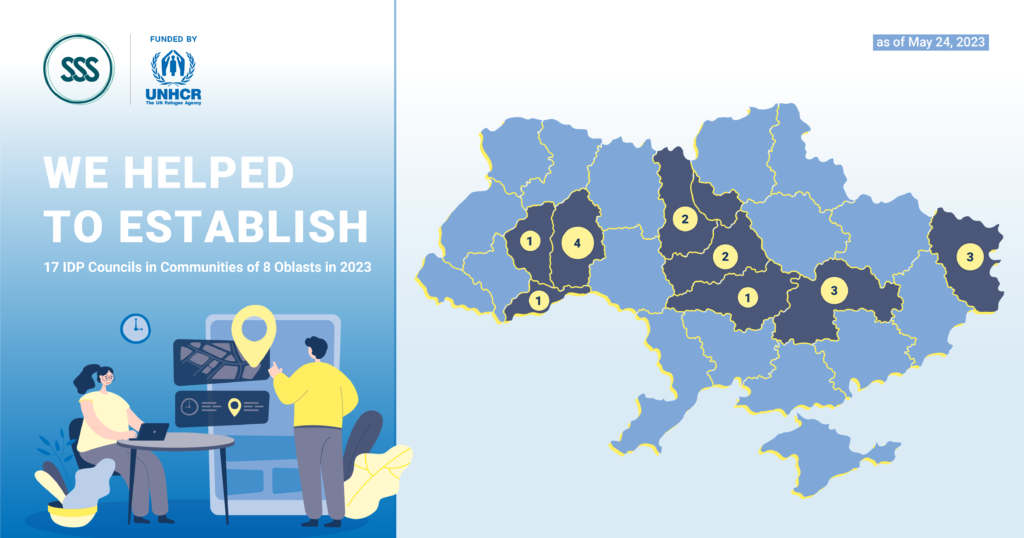
Since the year’s onset, we have facilitated the creation of 17 IDP Councils across 8 oblasts, including communities like Novomoskovsk Territorial Community (TC), Solonianska TC, Novopokrovska TC, Novoukrainska TC, Boyarska TC, Tetiyivska TC, Baikovetska TC, Medzhybizska TC, Slavutska TC, Dunayevetska TC, Chemerovetska TC, Monastyryshchenska TC, Voznesenska TC, Viknyanska TC. In the Luhanska Oblast, IDP Councils were formed under the Svatove City Military Administration, Troitske and Bilokurakyne Village Military Administrations.
Valeriia Vershynina, the project manager and legal affairs director of the Foundation, says:
“The primary objective of launching IDP Councils is to ensure efficient local level protection and support for IDPs. IDP Councils serve as advisory bodies that encompass NGO representatives advocating for the IDP community and working to their advantage. They bolster interaction between IDPs and local authorities, government agencies, and international partners. Moreover, they articulate the needs and suggestions of IDPs concerning their integration, rights realization, and public life participation. IDP Councils foster democratic values and a culture of dialogue between IDPs and communities, which is particularly crucial during times of war.”
Nataliya Savytska, the regional project coordinator in the Khmelnytska Oblast, who supervised the establishment of IDP Councils in four communities this year, adds:
“Our IDP Councils comprised civic-minded individuals active in civic affairs pre and post-displacement and willing to contribute. Concurrently, the recently formed Councils are led by either the community head or another decision-making authority. Any failure to honor their commitments carries reputational risks. Currently, the councils are endorsing annual work agendas.
Our team plays a pivotal role in the creation of IDP Councils, as we were the ones who initiated their creation. We incessantly encouraged the communities to progress, guiding the state apparatus in the right direction – benefiting both the IDPs and the local community. For a Council to function effectively, it is imperative to stay alert and navigate bureaucratic paths confidently by fostering communication with government officials.”
Other target communities are also making strides toward setting up IDP Councils. Olha Melnyk, the regional project coordinator in Rivnenska Oblast, discusses her experience with initiative groups from Mlynivska, Bilokrynytska, Zdolbunivska, and Klevanska TCs:
“Communities of the Rivnenska Oblast are proactive and dedicated to endeavors that enhance the lives of IDPs and facilitate their integration into the city or village’s social fabric. We were pleasantly surprised by the IDPs’ active involvement in the initiative groups aiming to form Councils. However, both the IDPs and the local community lack a comprehensive understanding of an advisory body’s operation. Hence, we regularly involve existing Councils to share their experiences.”
The team of the project “Supporting the Capacity of the Social Protection System to Register Internally Displaced Persons” aids in the establishment of IDP Councils in target communities, thereby integrating IDPs into the fabric of their new communities. This initiative is supported by the UN Refugee Agency in Ukraine.