
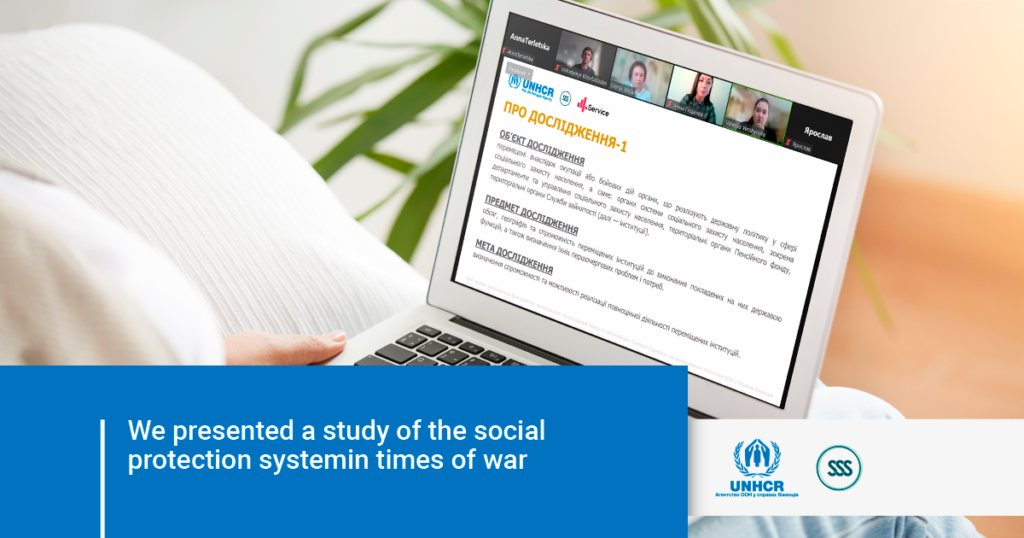
On February 13, the Charity Foundation “Stabilization Support Services” presented two major studies highlighting the capacity of social service providers in the context of war.
At the end of last year, together with the International Sociological Agency 4Service and leading lawyers of our charitable foundation, we analyzed the activities of more than 170 representatives of the social protection sector from eight oblasts – Donetska, Luhanska, Kharkivska, Zaporizka, Khersonska, Chernihivska, Sumska, and Dnipropetrovska. We conducted this research with the support of the UN Refugee Agency in Ukraine.
Based on in-depth interviews and testimonies of respondents, we outlined the main challenges faced by social service providers since the full-scale invasion and developed professional recommendations for amending Ukrainian legislation, which we shared with 89 attendees of our presentation.
“Cooperation with the Charity Foundation ‘Stabilization Support Services’ on the subject of protection of people affected by the war in Ukraine is very important for us. Working to ensure proper access to social protection bodies and ensuring their capacity is one of the key elements of our cooperation, which we plan to continue in 2023,” said Volodymyr Horbaladze, Legal Adviser at the UN Refugee Agency in Ukraine.
At the beginning of the presentation, Valeriya Vershynina, project manager and event moderator, emphasized the need to support social protection institutions: “The large-scale hostilities have led to the fact that social protection agencies were forced to relocate to safer areas. Quite often, this safety was relative. This had a significant impact on their ability to provide social services. Nevertheless, the system managed to withstand this overwhelming workload. People who provide social protection were able to resume work in a very short time. That’s why we decided to analyze and investigate how these relocations were carried out and how the system can respond to the challenges of wartime today. And most importantly, what lessons can be learned from this.”
Based on the research, we identified the main challenges in adapting the social protection sector to the new conditions and developed professional recommendations for the relevant authorities to support the sector. In particular, the authors of the reports focused on the following aspects of the work of social service providers in times of war:
- Evacuation and safety of personnel;
- Arranging working and living conditions at new locations;
- Stress in working with affected populations and human resources;
- The need to update material and technical support and introduce digital technologies.
The authors of the studies delivered speeches at the event: Nataliya Kryvosheyeva, Lead Lawyer at CF Stabilization Support Services, Olena Bikla, Candidate of Historical Sciences, Associate Professor of Sociology, and Hanna Padalka, Candidate of Sociological Sciences.
The in-depth interviews conducted by the researchers emphasized not only the challenges that social protection agencies faced but also their strengths. “The organizations showed superhuman capabilities, great cohesion, and motivation. When we asked the respondents, “What were you thinking about when the war started?” most of them said, “We were thinking about our clients. The war has come, but their needs have not vanished.” “We saw flexibility in reorienting their activities and making unique decisions in a crisis,” said Hanna Padalka.
The presentation was held on ZOOM and broadcast on our FB page. The event was attended by 89 people, mostly representatives of the social protection sector and NGOs working with affected populations. At the end of the event, a Q&A session was held for all participants. For example, one of the attendees asked about the problem of unequal approach to the social services system. Valeriya Vershynyna explained that service delivery systems differ depending on the size of the community, the number of people living on its territory, and the available budget. Therefore, the evacuation of different institutions was also carried out differently. Organizations had instructions but were not familiar with their practical implementation. In addition, these documents regulated a long evacuation process, for instance, over a period of two weeks, which was not an option for the social protection system.
“The study showed that where the social protection system is built around the local self-government system, decisions were made faster. Where employment and social protection departments operated, requests for recommendations on the evacuation procedure were first sent to the oblast administration and the ministry,” said Valeriya Vershynina.
The recording of the presentation is available on our FB page and can be accessed by all interested parties at any time. We thank everyone who joined the event, as well as the UN Refugee Agency in Ukraine, which made this study possible. Our Foundation will continue to research and support the social protection system in 2023.
Download the full reports here:
- Report on the results of the study to assess the capacity of relocated/evacuated organizations to provide social services in times of war: https://bit.ly/3luz6DR
- Report on the results of the study of relocated bodies of the social protection and pension system: https://bit.ly/3Ysftek