
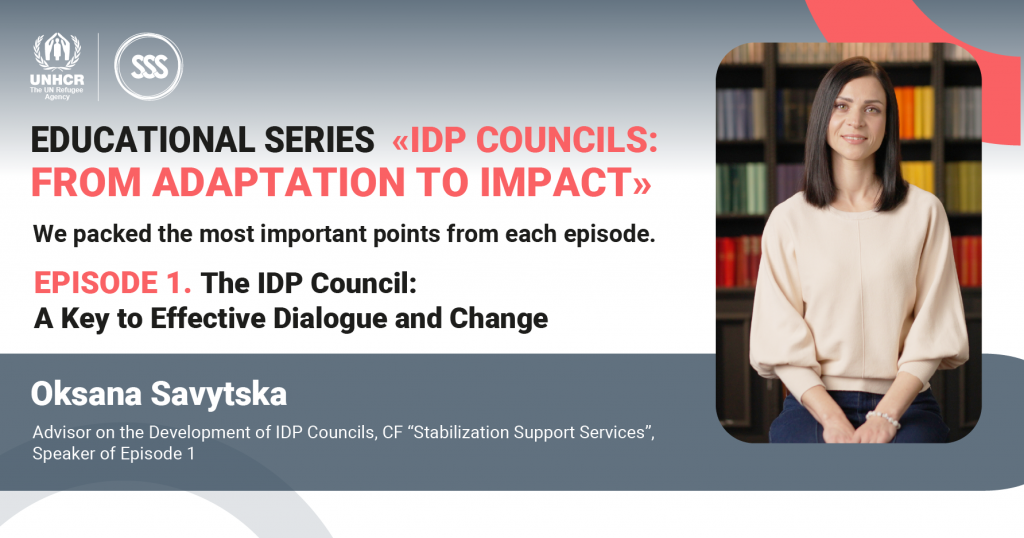
What is an IDP Council? Who can join it? How can an IDP Council become a powerful voice in the community? Where to start and how to plan the work of this advisory body?
You’ll find the answers in the first episode of our educational series “IDP Councils: From Adaptation to Impact” titled “IDP Council: The Key to Effective Dialogue and Change.”
Oksana Savytska, Advisor on the Development of IDP Councils, CF “Stabilization Support Services”, Speaker of Episode 1:
“The first episode lays the foundation for our educational series, as it covers the mission of IDP Councils and the features of their organization. By reviewing the legislation that regulates their work, we’ve gathered valuable advice on their areas of activity, based on years of practical experience from various councils.”
We have compiled key information from the episode into a concise summary. Watch the series, read the main points in text format, and save the cards on social media: Facebook and Instagram.
Summary of the episode “IDP Council: The Key to Effective Dialogue and Change”
Legal Status of IDP Councils
The IDP Council is a consultative and advisory body under local authorities that participates in regional policy implementation regarding the exercise and protection of rights of internally displaced persons (IDPs). It supports local communities and helps develop effective integration and adaptation mechanisms.
- The IDP Council can provide recommendations for improving living conditions for IDPs.
- The IDP Council cannot independently make decisions that alter local policies.
- No members receive a salary for their work in the IDP Council.
The Model Regulation on IDP Councils is the key reference for understanding their legal status.
Responsibilities of the IDP Council:
- Approve an annual work plan and report on its implementation
- Hold quarterly meetings
- Inform the public about its activities: publish meeting minutes, adopted proposals and recommendations, annual plans, and reports
- Provide contact information so IDPs can submit inquiries, suggestions, or report issues
- Support the development of a local integration program for IDPs
- Promote legal awareness among IDPs, particularly regarding available state and community support
Rights of the IDP Council:
- Request organizational, informational, and material-technical support from the authority under which it was established
- Create working groups and commissions
- Engage government representatives and independent experts
- Demand that local authorities review proposals within ten days
Who Can Be a Member of the IDP Council?
- Up to 30 people
- 50% must be IDPs
- 1/3 must be representatives of the authority under which the IDP Council was established
Council members are appointed for two years
Key selection criteria:
- Willingness to work on a voluntary basis
- Active participation in community work
- Concrete proposals for the Council’s activities
IDP Council Membership Formation Algorithm
Step 1. Approve the regulations on the IDP Council.
Step 2. Decide on the timeline and method for forming its composition.
Step 3. Appoint responsible persons and announce the application process.
Step 4. Approve the final composition of the IDP Council.
How to Amend the Composition of the IDP Council?
Changes to the Council’s composition are made by order of the head of the authority under which it was established, based on a proposal from the head of the IDP Council.
A Council member’s tenure may be terminated if they fail to attend meetings without a valid reason.
When can the IDP Council’s authority be revoked?
If the Council completes less than 60% of its planned tasks, local authorities may terminate its authority due to inactivity and announce the formation of a new composition.
Recommended Areas of Work for the IDP Council:
- Plan activities and allocate responsibilities among members — conduct strategic sessions
- Organize a data-driven work process
- Establish and strengthen partnerships
- Develop the Council’s capacity
- Engage experts and mentors
- Inform the public about its work and share important information for IDPs
- Develop and improve local targeted programs and regulatory acts
Not recommended:
- Providing social or legal services
- Assuming the responsibilities of local government bodies
- Participating in events unrelated to the Council’s objectives
Do you want to learn more about influencing local policy and making the lives of IDPs better? Watch the educational series “IDP Councils: From Adaptation to Impact” on the Diia.Education platform.
This publication was prepared with the support of the UNHCR, the UN Refugee Agency in Ukraine. The content of this publication is solely the responsibility of the Charitable Organization “Charity Foundation “Stabilization Support Services” and does not reflect the views of UNHCR.