
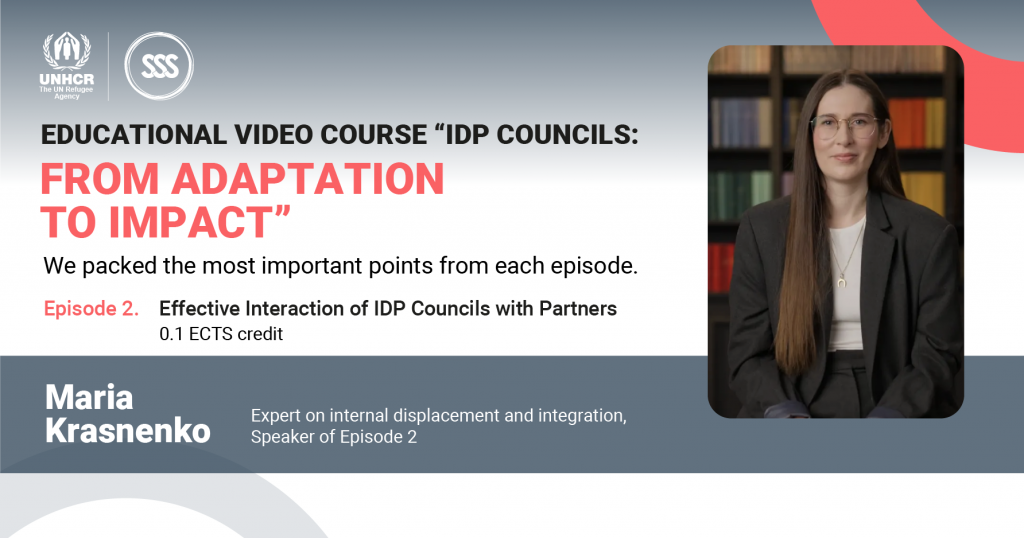
How can an IDP Council establish effective cooperation with its partners? Why were coordination hubs created, and how can one get involved in their work? How is the UN’s crisis response system structured during global humanitarian emergencies? Which clusters are currently active in Ukraine?
You’ll find the answers in the second episode of our educational video course “IDP Councils: From Adaptation to Impact” — “Effective Interaction of IDP Councils with Partners.”
Mariia Krasnenko, Еxpert on internal displacement and integration, Speaker of Episode 2:
“IDP Councils can and should engage at different levels: local, regional, and national. At the national level, UN tools can facilitate this, such as UN clusters or coordination hubs and meetings. Members of IDP Councils are already participating in meetings on the protection of the rights and freedoms of internally displaced persons, organized by the Office of the President of Ukraine.”
We’ve compiled the key information from the episode into a short summary. Watch the educational video course, read the highlights in text format, and share the cards on social media: on Facebook and Instagram.
Everyone who completes the course earns 0.1 ECTS credit.*
*The European Credit Transfer and Accumulation System, or ECTS, is a tool developed by the European Union to ensure compatibility between higher education systems across different countries.
Episode Summary: “Effective Interaction of IDP Councils with Partners”
Government Coordination Hubs
Coordination hubs are temporary advisory bodies under the Ukrainian Cabinet of Ministers established to coordinate efforts, identify problems, and find solutions.
Their members include representatives of ministries and central authorities, heads of oblast military administrations, and members of parliament. In their meetings, the hubs develop proposals and recommendations within their scope of competence.
These proposals and recommendations are documented in meeting minutes, signed by the chair and secretary, and sent to all hub members and the Cabinet of Ministers.
We recommend monitoring the current status of coordination hubs and any potential changes in their operation.
Cluster System and Its Structure
The UN’s response system is activated in countries experiencing global humanitarian crises. The humanitarian cluster coordination system brings together national and international humanitarian organizations, UN agencies, and other stakeholders.
The cluster system has been operational in Ukraine since 2014. The following clusters are currently active:
- Protection Cluster
- Shelter and Non-Food Items (NFI) Cluster
- Camp Coordination and Camp Management (CCCM) Cluster
- Health Cluster
- Education Cluster
- Logistics Cluster
- Others
A complete list of clusters, their contacts, and activity details is available here.
Protection Cluster
Its main task is to ensure legal and social protection across all areas of human rights (human rights, international humanitarian law, refugee rights, etc.).
Main activities:
- Social support
- Emergency cash assistance for protection
- Hotlines
- In-kind protection assistance
- Legal aid
- Other
How IDP Councils can participate:
- Join regional coordination meetings,
- Involve partners in the response efforts,
- Access information on organizations supporting IDP Councils,
- Share IDP Council best practices with partners,
- Refer individuals in need of assistance.
Find out more about the cluster’s work via the link.
Camp Coordination and Camp Management Cluster (CCCM)
This cluster began its operations in March 2022 in response to the large-scale accommodation of displaced people in schools, kindergartens, dormitories, sanatoriums, and other converted housing facilities.
UNHCR leads the CCCM Cluster in Ukraine.
The main task is to coordinate the protection of IDPs in collective sites and improve their living conditions by providing technical support, access to information, and recommendations.
Note: This cluster does not have a separate budget.
The cluster has developed a map of IDP accommodation sites.
Shelter and Non-Food Items (NFI) Cluster
The cluster’s main task is to coordinate humanitarian aid related to housing and NFIs for people affected by the war.
Main activities:
- Assessing shelter and NFI needs
- Providing housing and technical assistance
- Winterization support
- Coordination and collaboration
- Ensuring safety and dignity
- Supporting recovery and sustainable development
Find out more about the cluster’s work in Ukraine via the link.
Do you want to learn more about influencing local policy and improving the lives of IDPs?
Take the video course “IDP Councils: From Adaptation to Impact” on the Diia.Education platform.
This publication was made with the support of UNHCR, the UN Refugee Agency in Ukraine. The content of the publication is the sole responsibility of the Charitable Organization “Charity Foundation “Stabilization Support Services” and does not reflect the views of UNHCR.