
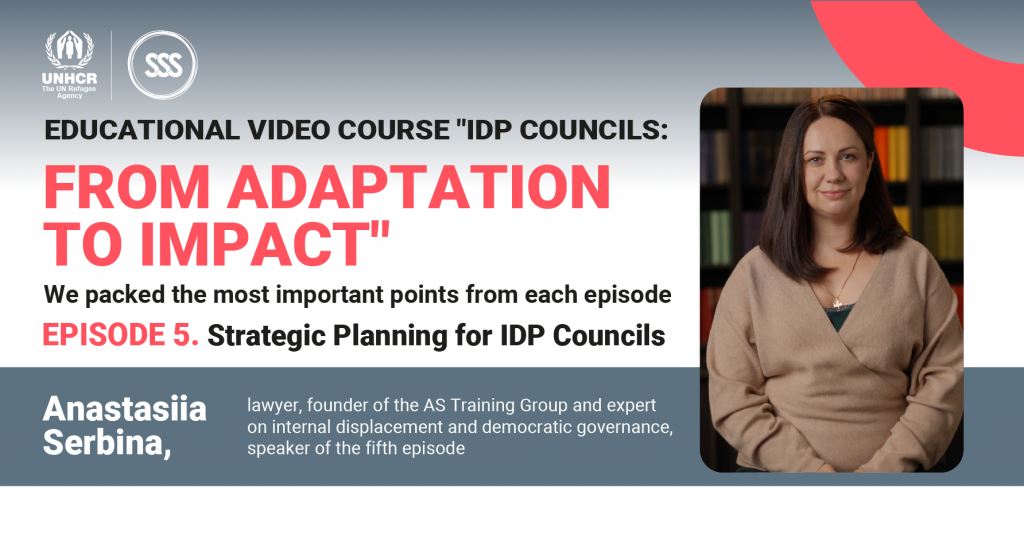
How does strategic planning help IDP Councils in their work? Where to start when developing strategic and operational plans? What does it take to prepare a high-quality report on the work of an IDP Council, and how to present its achievements? You will find the answers in the fifth series of our training video course IDP Councils: From Adaptation to Impact — “Strategic Planning for IDP Councils.”
Anastasiia Serbina, lawyer, founder of the AS Training Group and expert on internal displacement and democratic governance, speaker of the fifth episode:
“In this episode, you will learn about strategic planning methodology. You will understand how to correctly identify priority areas of work, set achievable goals, and report on results so that your activities are transparent and understandable to communities, partners, and internally displaced persons.”
We have compiled the key information from the episode into a brief summary. Watch the training video course, read the key points in text format, and save the info cards on social media: Facebook and Instagram.
All who complete the course will receive 0.1 ECTS credits*.
*The European Credit Transfer and Accumulation System, or ECTS, is a tool developed by the European Union to ensure the compatibility of higher education systems in different countries.
Summary of the “Strategic Planning for IDP Councils” episode
What is strategic planning?
The purpose of strategic sessions is to identify priority areas of work and set relevant, achievable, and effective goals.
An important tool for strategic planning is SWOT analysis. It will help session participants:
- Identify the strengths and weaknesses of the IDP Council
- Find opportunities for development and improving efficiency
- Anticipate potential threats that may stand in their way.
How to conduct a strategic session?
One way to work with a team is to constantly change the focus:
- Look at certain things or phenomena from a distance or as closely as possible.
- Change your perspective (discuss issues from the point of view of, for example, displaced persons, the community, local authorities, or the country as a whole).
An effective method for setting goals is the SMART technique, which allows you to define a goal in terms of its specificity, measurability, achievability, relevance, and time-bound nature.
Work formats:
- Individual work
- Work in microgroups, small, and medium-sized groups
- General discussion.
Use brainstorming! It is a powerful tool that helps generate the most creative ideas in a short period of time.
Results of the strategic session
A strategic plan is a document that provides a detailed description of the IDP Council’s work, defines its mission, vision, and values, and includes an analysis of the situation and plans for the future.
An operational plan is a detailed instruction, a step-by-step algorithm for actions that helps to achieve the defined strategic goals.
Reporting by IDP Councils
The IDP Council must report annually on its work. This can be done either at the end of the past year or at the beginning of the new year for the previous one.
The report should reflect the full scope of the work carried out and be objective and truthful.
Presentation of work and achievements
The work and achievements of the IDP Councils should be periodically presented through relevant communication channels:
- Social networks
- Media
- Personal meetings with various target groups
- Own events
- Informational materials
Be visible, talk about what you are doing, show results, good practices, and success stories!
Please note! Do not forget to post information on the website of the local government body under which the IDP Council was established.
Want to learn more about how to influence local policy and improve the lives of IDPs? Take the video course “IDP Councils: From Adaptation to Impact” on the Diia.Education platform.
The training course (educational series) was created by the Charity Foundation “Stabilization Support Services” with the financial support of UNHCR, the UN Refugee Agency in Ukraine, for the Diia.Education platform.
This publication was made with the support of UNHCR, the UN Refugee Agency in Ukraine. The content of the publication is the sole responsibility of the Charitable Organization “Charity Foundation “Stabilization Support Services” and does not reflect the views of UNHCR.