
Social protection is always about people. First and foremost, it is about people who need support during major shifts in their lives: moving, losing their homes, property, jobs, family or loved ones, or plans for the future. Often, these people are experiencing stress as they try to adjust to the new environment and adapt to a place where they can feel safe. Given the context of the war, this feeling is elusive even for those who did not have to start their lives over. We can only imagine how difficult it is for people who have lost something important.
Social protection is also about people who, no matter what, have to support others and are their guides to the world of public services that can help people get back on their feet faster. These are the professionals who register IDPs, assign them social benefits, help them find employment and housing, and enroll them in social programs. These people also need support, as the demand for assistance is much higher than the social protection system is able to provide, in particular, due to a lack of technical and human resources.
Therefore, in 2024, our Foundation will continue implementing the Supporting the Capacity of the Social Protection System to Register Internally Displaced Persons project, which is being implemented with the support of the UN Refugee Agency in Ukraine. The project team works in all oblasts except for the temporarily occupied territories. Here are three key areas of our work.
- Providing assistance to people affected by the war, including IDPs
We continue to support those who need help and protection today, including IDPs and refugees. Our legal team provides advisory support to people who contact us through a Google form or through the network of regional project teams.
We offer expert and personalized consultations and provide information on the procedure for applying for and receiving public services. If we are unable to address the issue within the project, we make a referral to another service provider who may be able to help.
We also provide secondary legal aid. In particular, we assist in drafting procedural documents for applying to the court on issues related to the restoration of the violated right of IDPs to social protection or establishing facts. This service is available in Donetska, Zaporizka, Luhanska, Mykolaivska, and Khersonska oblasts, provided that there are no free legal aid centers there.
We will also publish awareness materials (printed and online) throughout the year. They will explain how to receive public services and answer frequently asked questions about government support for IDPs.
- Building the capacity of governmental and non-governmental actors in the field of social protection of IDPs and other people affected by the hostilities
This section is about supporting those who provide assistance. We plan to continue optimizing the process of registering IDPs in their new locations by updating the necessary technical equipment (computers and components, printers, routers) at social protection institutions. Thus, we plan to equip 120 workplaces in 10 oblasts and transfer 288 mechanical and electric tricycles for employees of social protection departments in all oblasts.
In addition to updating the equipment, we have planned ongoing education and training for employees of social protection departments and divisions. We do this in order to strengthen their knowledge and skills in the current legislative framework in the field, operational support and its management, organization of workflows, etc.
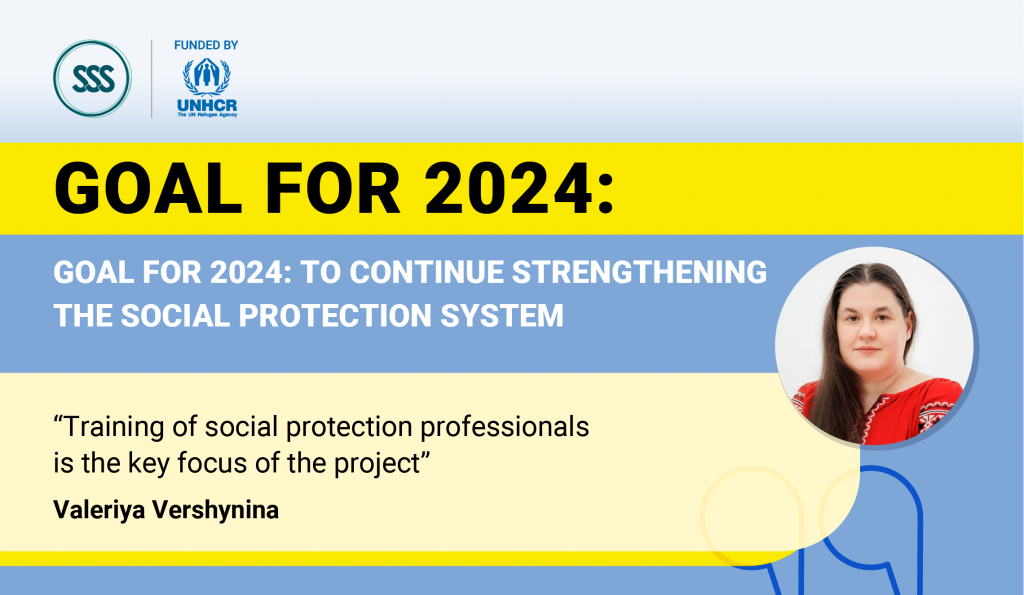
Project manager Valeriya Vershynina noted, “We see that the need for knowledge and training of social protection workers is complex. Therefore, the professional development of these professionals is a key focus of the project. Even the knowledge they had and the institutional memory they had developed over the 10 years since the start of hostilities has virtually disappeared as a result of significant displacement. We need to restore that.
The social sphere mostly consists of women of pre-retirement and even retirement age who have not had experience working with IDPs. Therefore, it is important for us to teach them basic skills of working with Excel and Google Docs, as they have to prepare reports. These skills allow us to optimize the process of IDP registration and the assignment of proper benefits.
Also, social protection workers need to have a comprehensive understanding of the policies in the field of IDP services: what documents are valid and what information can be used in their work. We train employees on what decisions they can and should make on their own instead of sending people to court every time they are afraid of questions about employment or pensions because they don’t know how to resolve the situation. At the same time, we look at what issues are the most difficult for them and what is the most requested, prepare webinars and trainings on these topics, and conduct training.”
- Creating durable solutions for vulnerable groups
Durable solutions are always about a lot of hard work and time, the results of which may not be immediately visible. However, they have the greatest impact on the future, as they allow us to study the situation in depth and formulate an expert plan to improve it.
Thus, this year, we continue to support communities in updating their social passports and implementing plans for the development of the social protection system. Thanks to these documents, communities can develop faster and find support from government and private investors. In 2023, with the expert support of our regional teams, we developed medium-term social protection system development plans for 56 target communities in 14 oblasts of Ukraine. In 2024, our Foundation will support and advocate for communities in implementing these plans.
Another of our activities, the analysis of durable solutions for social housing for IDPs, is dedicated to the study of local housing policies that directly affect the accommodation of IDPs in new places. In each selected oblast, we identify potential social housing facilities, analyze their condition and make recommendations to local authorities on how to utilize them for IDPs.
The project will also coordinate the analysis of local social protection policies and targeted programs related to social protection. The main goal of this activity is to determine the extent to which the needs of IDPs are taken into account in the target communities and to formulate proposals that IDP Councils can use to shape (adjust) the framework of their activities. A report will be created for each community, which will contain an analysis of local policies and existing social programs, as well as recommendations for making appropriate changes and additions.
The project team continues to build the capacity of IDP Councils by providing them with organizational and methodological support. In 2023, we established 105 IDP Councils in 21 oblasts, and all of them require capacity development. In particular, we plan to carry out 68 monitoring studies of local policies and programs with the involvement of IDP Councils to form the framework for their further activities; organize 96 one-day training sessions and workshops; and hold 48 strategic sessions. This year, we are also implementing a comprehensive mapping of IDP Councils.
A separate area of our work is to empower the activities of the Ombudsman’s Office. As part of our cooperation, we will provide organizational support for monitoring visits and field meetings, as well as information support. In addition, we will organize training events for the Office staff.