
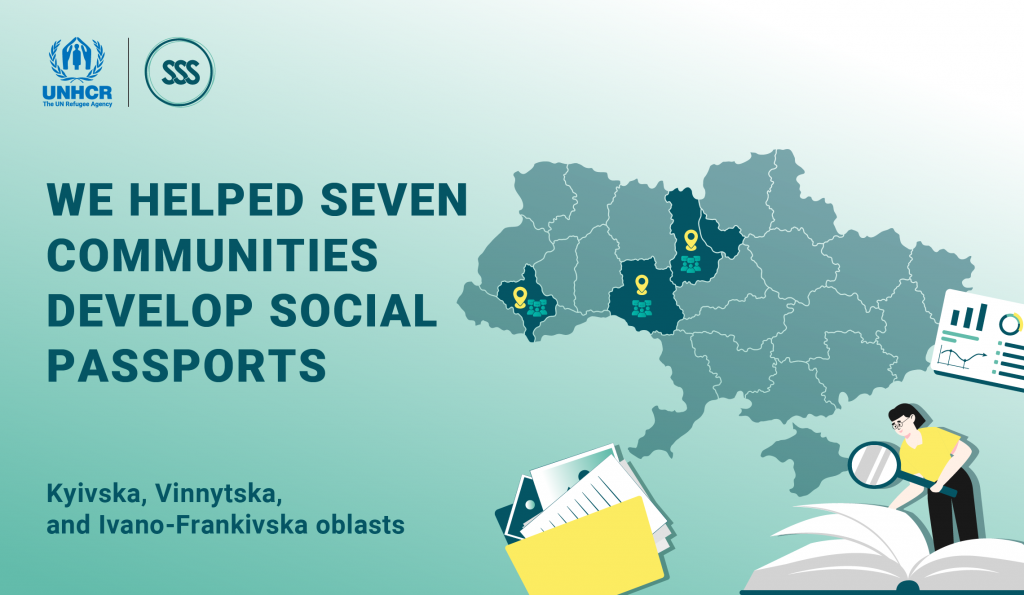
The full-scale war in the country has caused the number of people in need of social support and protection to increase. That is why, throughout 2024, we have continued assisting target communities in assessing the accessibility and quality of social services and in developing social passports.
A social passport is a document that contains up-to-date information on a community’s resources and social characteristics, allowing for an evaluation of its potential.
Over the past year, our regional teams have helped develop social passports for the following communities:
- Buchanska, Borodianska, Vasylkivska, and Obukhivska (Kyivska Oblast)
- Bershadska and Voronovytska (Vinnytska Oblast)
- Ivano-Frankivska
Yuliana Hasanbekova, project coordinator for the development of social passports, shares insights on the cooperation with the communities:
“The Buchanska and Borodianska communities suffered the most destruction as a result of the Russian invasion; Vasylkivska and Obukhivska have accommodated a significant number of displaced persons. All of them are open to cooperation with communities relocated from the temporarily occupied territories: they are assisting in resolving housing issues and providing social support. A social passport enables the coordination of actions, implementation, and expansion of necessary services and the identification of resources and capacities for the sustainable development of these territories. Moreover, this document, of course, offers investors and donors a portrait of the community, its capabilities, and its political will to change and act.
Ivano-Frankivsk is a powerful oblast center that has sheltered tens of thousands of IDPs. The development of the social passport for the Ivano-Frankivska community has allowed for an updated social profile, reflecting changes caused by the war. The community has significant potential for social sector development through the involvement of local self-government authorities and the civil society sector.
The communities of Vinnytska Oblast, Voronovytska, and Bershadska, sought to create a social passport to understand their social realities. The decentralization reform has been completed, but the war has prevented a full inventory of resources, the identification of a social profile, and an assessment of social service needs. The development of the social passport has provided answers to these questions.”
The social passport will serve as the foundation for developing plans to improve social protection systems in these communities.
In upcoming publications, we will share the results achieved by communities thanks to these studies and the development of the documents.
We helped communities compile social passports as part of the Supporting the Capacity of the Social Protection System to Register Internally Displaced Persons project, funded by UNHCR, the UN Refugee Agency in Ukraine.