
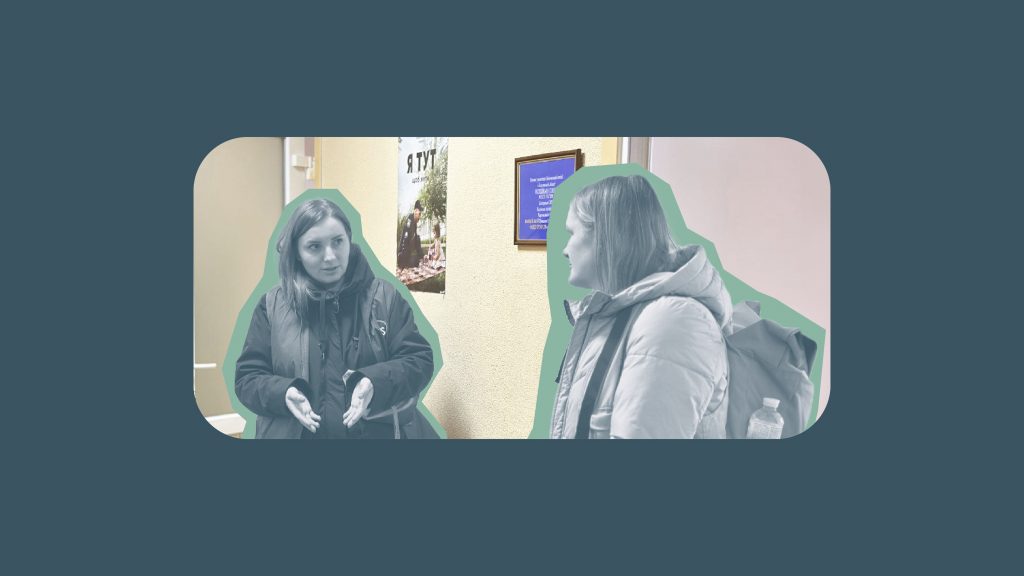
Have you noticed that fewer humanitarian aid kits are being distributed, while more training sessions, seminars, and forums are being organized for affected populations? Does this surprise you? Have you wondered whether this is the right focus at the moment? To explore these questions, we spoke with Anna Borysova, Foundation’s Director for Humanitarian Response.
– Anna, recently there has been much discussion and activity around post-war recovery and rebuilding. Isn’t it too early for this?
– The war continues, but it will inevitably end. How we face its conclusion depends on us too. We cannot control what the enemy does, but we can influence our own actions, expectations, and how we plan for the future. Of course, it’s challenging to plan when tomorrow is uncertain, but it is necessary.
– If planning post-war recovery is so important, why are there doubts about its relevance right now?
– Distributing aid kits or repairing homes is easier to understand. This is immediate assistance: you can see it, receive it, and use it right away. But when we aim for at least medium-term results — developing recovery plans or local development programs, acquiring new skills and knowledge — we have to be aware these outcomes are not immediately visible. From this perspective, it may seem much better to focus solely on distributing humanitarian kits. However, without new skills and knowledge, people cannot independently improve their quality of life or move forward.
— So, education and development remain important even for people who have been affected by the war?
— There is a maxim: teach a person to plant a tree, rather than just giving them the fruit. It’s important not only to provide food to those who lack it but also to teach them how to secure it for themselves in the future. Our projects incorporate planning, attempts to forecast the future, and finding answers to how we will live in it, what we will need to have and know to be ready for the challenges that inevitably arise when the flow of humanitarian aid decreases in the post-war period. We need to learn to take care of ourselves.
— Does this mean the Foundation is ceasing the distribution of humanitarian aid kits altogether?
— No, the kits will remain, because to engage in planning, to think about the future, and what we need to live better, it’s essential to address the immediate urgent needs for food and hygiene. After all, it’s very difficult to think about how to develop youth in a community, business, or any other sector when you don’t have enough to eat, the windows are boarded up with plywood, and there hasn’t been electricity in your home for a year. Everything must be done in a comprehensive manner. I believe people can participate in community development when their basic needs are met.
— How do you balance the allocation of resources between humanitarian aid and recovery planning?
— This balance is at the core of our new project, Strengthening Resilience and Protection of Conflict-Affected Individuals, Communities, and Systems in Central and Eastern Ukraine. First, it involves repairing people’s homes so that they feel more comfortable and are then ready to help others. Second, it engages them in creating and implementing recovery plans for their communities.
— Everyone is talking about community recovery plans these days. What are they?
— Right now, we need to plan how to restore our communities to life, rebuilding every sphere while accounting for losses and opportunities. We aim to help communities identify their growth points, understand what they can do better, where they face challenges, what they should pay attention to, and what can become their strength. After that, as part of the project, we will provide communities with microgrants to implement their plans and assist them in carrying out these initiatives. This means communities will gain experience with grants — from applying for them to submitting reports — and this is important. At the same time, we will help these communities repair water utilities, municipal enterprises, and temporary housing facilities for IDPs.
In essence, we are preparing people so they can later implement their plans and develop their communities. We expect that by the time the project ends, individuals and communities will have the strength and capacity to independently address the challenges that arise after the war.
The Strengthening Resilience and Protection of Conflict-Affected Individuals, Communities, and Systems in Central and Eastern Ukraine project is implemented by the Charity Foundation “Stabilization Support Services” in cooperation with the international humanitarian organization CARE, with the support of the German Federal Ministry for Economic Cooperation and Development.