
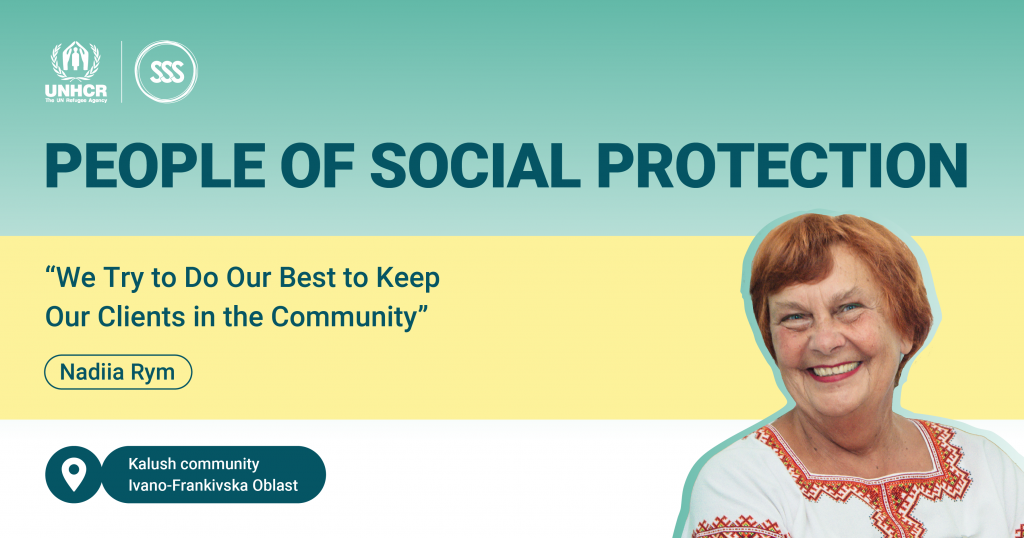
Nadiia Rym is the third heroine of the annual People of Social Protection project, where we tell about the work of social protection institutions in different oblasts of Ukraine. Nadiya has been working as the director of the Territorial Centre for Social Services in Kalush for ten years. In the interview, she emphasises the needs of not only the centre’s clients, but also its employees who provide social services in the Kalush community. “Only enthusiasts can do such hard work for the minimum wage,” says Nadiia, describing her team.
The Kalush community includes the city of Kalush and 16 villages. The staff of the centre regularly travel long distances to visit lonely people who need help at home. To make their work easier, we donated six bicycles (three electric and three mechanical) to the centre.
We talked to Nadiia Rym about the services provided by the territorial centre, the needs of its team and clients (including IDPs), the most difficult things in the work of social workers, and the institution’s plans for the next year.
About the Territorial Centre
Nadiia, tell us about the Kalush community. How many IDPs has it received?
The centre of the Kalush community is the city of Kalush, where about 60,000 people live now. In total, there are about 90,000 people in the community. The peak number of IDPs was in 2022, when about 10,000 people arrived, including many Kyiv residents. As of August 2024, 4896 IDPs were registered in the community.
What are the key tasks of the territorial centre of the Kalush community?
The territorial centre employs 47 people. We provide three social services: care, in-kind assistance and social adaptation.
Care services are provided by 35 social workers. They come to the homes of lonely elderly people, bring them groceries, medicines, clean, cook and help with all household chores. These clients walk around the apartment or house, i.e. they are not bedridden, but they are mostly unable to go out. So they need help at home.
Lonely low-income people receive in-kind assistance. There are about 700 of them on the register. For example, last year we provided them with in-kind assistance (food and various services) worth UAH 283,000. About half of these funds were received from the city budget, and the other half from philanthropists. We have a charity fund to which we can transfer money for such needs.
We provide social adaptation services to about 160 people in the community. We hold recreational classes at the stadium and in gyms, Nordic walking classes, teach them how to use computers, tablets and smartphones. We try to do our best to keep these people engaged in the community and feel involved.
About Supporting IDPs
What are the main needs of IDPs in the Kalush community?
The main problem of IDPs in our community is high-paying jobs and housing. Most IDPs live in apartments and pay rent. There is state compensation, but the rent is still not fully compensated. However, with the help of philanthropists, we were still able to partially resolve this issue. At their expense, the community has renovated three shelters for 81 people who live there for free.
Thanks to the benefactors’ funds, a geriatric centre was also opened, which had never existed in Kalush. The centre is now home to internally displaced people, mostly from Donetsk Oblast, who receive food and care. Most of them are already bedridden or almost unable to walk. The city council pays salaries to the staff for the service, finances the meals, and the state compensates for the IDPs’ utility costs.
About the Needs of the Territorial Centre
What has been the biggest challenge and success for the territorial centre since the beginning of the full-scale invasion?
I was very afraid that we would lose our employees. In the first days of the full-scale war, many of my employees went abroad. I thought they would never come back. They all came back, and this is our greatest success. Everyone is working, despite their low earnings. Social workers, who bear the brunt of care at home, receive the minimum wage. There is a small bonus, but it is very little.
In August, our foundation, together with the UNHCR, handed over bicycles for the workers of the Kalush Territorial Centre. How does this help make their work easier?
This is a great help, we are grateful to your team. These bicycles make the work of those who work in villages where there are distances of several kilometres from one house to another, and they also have to go to the store. For example, Tetiana, a social worker in the Ripyanka district, works in two small villages with few people. She would either ride her bike or take her husband’s car. It was unrealistic to get around on foot. Now she has an electric bike.
Or there is a huge village called Golyn. I once went there for a check-up by car and wondered how social workers cover these distances. They all have ordinary bicycles. But now they ride electric, three-wheeled bikes with a large luggage rack — it’s much more convenient.
Apart from new vehicles, what else could improve the work of the territorial centre?
Raising salaries. Because this is really a huge problem. Just the other day (at the end of summer. — Ed. note) we received a request from the Ministry of Social Policy. They are also concerned that people want to quit. We had two employees quit. Only enthusiasts can do such hard work for the minimum wage.
Low wages are the main problem, there are no other serious problems. Our office is simple, but we can work, for God’s sake, it’s a war… We would be happy to get a couple more bicycles. Because even in Kalush there is a private sector. There, too, you have to walk a long way to get from one ward to another. Maybe the city council will help, we will at least ask.
About Social Work
What character traits are most needed in the field of social protection?
The ability to compassion, willingness to help, humanity are the main qualities needed in our work. Some of my employees say that the hardest part is burying their clients. They get used to them, and this is a strong moral burden. Perhaps it would be good to launch psychological trainings for social workers to help them develop resilience. I’m not just talking about Kalush, such a project could be implemented across the country. It can be free psychological help, with on-site visits, because my employees cannot go to Ivano-Frankivsk. They might be interested in attending such trainings.
Please share your territorial centre’s plans for 2025. What areas would you like to develop?
We want to expand cooperation with philanthropists to help those in need. We want to increase the payroll fund from the local budget. Continue to develop the University of the Third Age, in particular, to launch training in computer literacy and the safe use of modern means of communication. Involve more local institutions in joint work. For example, we have two swimming pools — we can arrange free swimming for my students. In general, we plan to work more or less as usual.
This material was prepared by the CO “Charity Foundation “Stabilization Support Services” with funding from the UN Refugee Agency in Ukraine (UNHCR). The contents of this publication are the sole responsibility of CO “CF ‘’SSS‘’ and can in no way be taken to reflect the views of the Agency.