
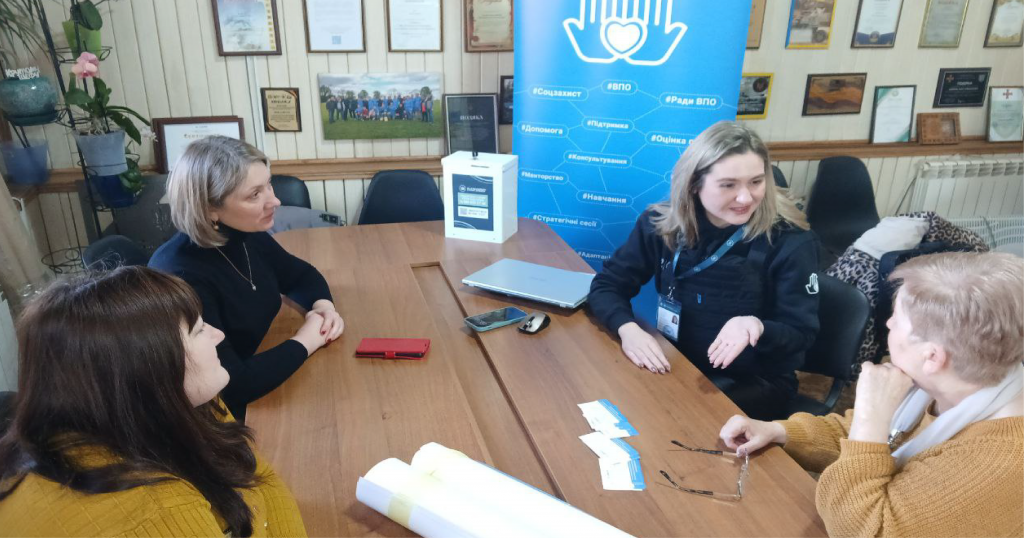
Our project to support the capacity of the social protection system continues. From assessing the needs of social institutions to consulting with IDP Councils, we report on the key results of our team’s work in February.
Support for hromadas and social protection institutions
In February, the project team focused on getting ready to work with hromadas in 2026. We figured out which hromadas would be part of the project and started checking out the needs and abilities of social protection agencies, social service providers, and IDP Councils. This will help us plan better support for hromadas going forward.
During the month, 65 coordination meetings were held with representatives of local authorities, social protection institutions, civil society organizations, and IDP Councils. During the meetings, the project was presented, hromada needs were discussed, and formats for cooperation were determined.
A separate area of focus was advisory support for social protection system specialists. In February, 275 employees of social protection institutions received consultations on social benefits, pensions, housing programs, IDP registration, and the organization of the provision of social services.
Regional coordinators of the Ombudsman’s Office conducted 211 monitoring visits to institutions where people affected by the war are staying or receiving services. These included 62 temporary accommodation facilities, 24 educational institutions, and 125 shelters. During these visits, IDPs received advice on access to medical services, social benefits, housing rights, and opportunities to receive compensation for destroyed housing.
Support for IDP Councils
In February, the project team conducted 173 monitoring visits to assess the capacity of IDP Councils that are planned to be supported in 2026. The results of this assessment will help determine the formats for further support of IDP Councils within the project.
In addition, 158 representatives of 86 IDP Councils received legal advice. Most often, the inquiries concerned the powers and tasks of the Councils, the procedure for their establishment and renewal of their membership, as well as the participation of IDP Councils in local decision-making processes with the aim of protecting the rights of displaced persons.
Regional teams also provided coordination and mentoring support during 10 IDP Council meetings.
Communication and access to information
In February, we prepared and published two series of informational materials for IDPs — on the resumption of pension payments and identification procedures for pensioners. We also developed a campaign concept aimed at informing internally displaced pensioners about the potential reasons for the suspension of pension payments and the steps necessary to resume them.
The training video course for IDP councils, From Adaptation to Impact, continues to attract new participants: 102 people registered in February, and 54 successfully completed the course and received certificates.
The Portals of IDP Councils online platform remains an important information resource for the community. In February, it received over 1,100 visits. The project team prepared 14 publications and sent out four newsletters with useful information for IDP Councils.
Providing information on the protection of the rights of IDPs and other people affected war
In February, 64 IDPs and other people affected by the war received information on the protection of their rights. Most of the inquiries concerned the functioning of the Register of Damages for Ukraine, in particular the categories of applications that are currently open for submission, social benefits and pensions, humanitarian aid, and housing issues.
Advocacy
In February, we actively advocated for the removal of administrative and legal barriers to receiving pensions for people affected by the war. Representatives of the Foundation met with the Minister of Social Policy and the Head of the Pension Fund of Ukraine, and also participated in parliamentary hearings and a coordination meeting with the Office of the President. As a result of these advocacy efforts, changes were made to the Procedure for the Payment of Pensions (Resolution No. 299), in particular, the deadline for submitting documents was extended to April 1, 2026. Recommendations were also developed to improve information dissemination to the public, simplify procedures for accessing pensions, and improve legislative regulation.
Special attention was paid to strengthening the role of IDP Councils. Advocacy continues for amendments to the Model Regulations on IDP Councils, the creation of a mechanism for mapping them at the level of the Ministry of Social Policy, and the enshrinement of mandatory consultations with IDP Councils in draft law No. 12301 and the State Policy Strategy on Internal Displacement.
We are implementing all these initiatives thanks to the Support to the Capacity of Government Institutions and Local Hromadas to Strengthen Social Protection Systems in Ukraine project, which is being implemented with the support of UNHCR, the UN Refugee Agency in Ukraine.