
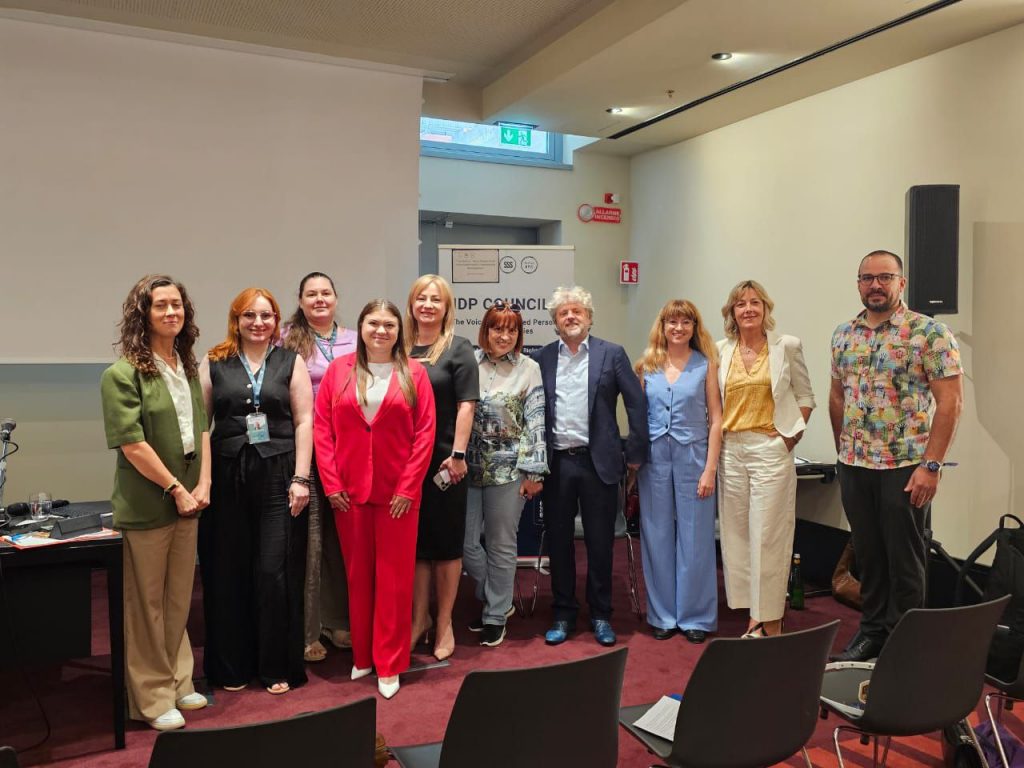
On the sidelines of the Ukraine Recovery Conference, Ukrainians presented recommendations and best practices for involving IDP Councils, the diaspora, and refugees in the recovery processes.
This was discussed at the roundtable “ONE NATION – MANY HOMES: FROM LOCAL LEADERSHIP TO TRANSNATIONAL REINTEGRATION” in Rome on the eve of the Ukraine Recovery Conference, where multi-billion investments in the country’s recovery will be deliberated. Representatives of IDP Councils and Ukrainian and international civil society organizations organized a separate side event with the participation of international experts and government officials after initial attempts to organize it within the framework of the main conference were unsuccessful.
International Experts Affirm Support for Ukrainian IDP Councils
The UN Special Rapporteur on the Human Rights of Internally Displaced Persons, Paula Gaviria Betancur, announced the extension of her mandate for the next three years and pledged to continue fostering the development of the IDP Council network and supporting displaced persons in Ukraine and worldwide.
“Internally displaced persons are not just recipients of aid; they are not merely victims. They are rights holders, citizens, agents of recovery, agents of change, agents of peace,” Betancur stated, joining the event online.
Elissa Golberg, Ambassador of Canada to Italy, spoke about the Canadian government’s support: of the $19 billion allocated to Ukraine, $12 billion is directed to support public services — including pension payments and assistance for internally displaced persons.
Netherlands Supports Project for Dialogue Between Ukrainians
An important announcement was made at the roundtable regarding the launch of a new project for structured dialogue between Ukrainians in Europe and IDP Councils in Ukraine. Doron Verstraelen from the Ministry of Asylum and Migration of the Netherlands said that his country is keenly interested in the results of the project, which is being implemented by the Ukrainian Charity Foundation “Stabilization Support Services” and the Dutch organization OpenEmbassy.
“This is primarily a person-to-person dialogue,” Verstraelen emphasized, adding that such a format will help to better understand the needs of Ukrainians for policy formulation in both countries, “We will create programs in education and entrepreneurship within key sectors of the Dutch economy, which are also crucial sectors of the Ukrainian economy.”
The first meeting took place in early July and focused on the shared needs of Ukrainians in the Netherlands and Ukraine.
IDP Councils as a Mechanism for Participation in Local Recovery
Valeriia Vershynina, Executive Director of Charity Foundation “Stabilization Support Services” and co-founder of the Congress of IDP Councils, noted, “IDP Councils are actively involved in local-level recovery projects — both in consulting on infrastructure reconstruction and in developing programs for the population. However, their engagement in changes at the national level is insufficient. Many decisions, programs, and strategies are adopted without considering the opinions of displaced persons. We need systematic cooperation among the government, donors, IDP Councils, and other representatives of the affected population. We call on the government to assume a leadership role in this process.”
Today, over 800 IDP Councils operate in Ukraine across 66% of all communities where displaced persons reside.
Anna Chernova from the charitable foundation Posmishka UA urged against limiting the role of displaced persons to merely service recipients, “We view IDP Councils as a strategic partner, rather than simply a service agency, because I believe their true purpose is not to be service agents. Please involve us as local actors who are already connected with communities.”
Martina Ranieli, Head of Department at the International Institute of Humanitarian Law, emphasized the importance of creating neutral and safe spaces for dialogue between the government and displaced persons, as mutual understanding can best emerge under such conditions.
“We are working to ensure that people with displacement experience become co-creators of various projects and programs and have a space to address governmental officials from around the world,” she noted.
Systemic Coordination Problems
Problems of return are associated not only with security but also with systemic challenges in the state’s policy regarding displaced persons. Yana Liubymova, co-founder of the Congress of IDP Councils, spoke about the preparation of a generalized advocacy position on IDP policy with the support of the International Renaissance Foundation, “We identified 11 key challenges, one of which is the lack of clear coordination after responsibility was divided between the Ministry of Communities and Territories Development and the Ministry of Social Policy.”
“The most important aspect is the recognition of IDPs as partners in the recovery process, as my colleagues mentioned earlier,” she added. “This document we presented today is not a final outcome. It is a call to action.”
Alyona Luniova from the ZMINA Human Rights Centre also addressed the lack of coordination at the ministerial level following the liquidation of the Ministry of Reintegration at the end of 2024.
She spoke about the joint statement of human rights organizations, “My colleagues and I issued a statement emphasizing the necessity of including the agenda of temporary territories in the agenda of the Ukraine Recovery Conference. Because for now, these problems are not in the focus of discussions about human capital.”
Need for a New Strategy for 6 Million Ukrainians
Olga Tokariuk, a researcher from London’s Chatham House, presented the results of a study on Ukrainians abroad, which revealed a troubling trend: according to the Kyiv Centre for Economic Strategy, the proportion of those intending to return decreased from 70% in 2022 to 44% in May 2025.
Significantly, 55% of Ukrainians abroad originate from eastern and southern regions, with many having experienced double displacement — first in 2014, then in 2022.
“These individuals may feel the most vulnerable, but at the same time, they often feel the closest emotional connection to Ukraine,” the researcher noted.
Practical Results
The event’s participants agreed on the development of a political document with recommendations for governments, the creation of a network of partnerships between IDP Councils and organizations of Ukrainians abroad, and the launch of cross-border platforms for dialogue and return support.
Context
The roundtable took place on the eve of the main Ukraine Recovery Conference in Rome, where international donors will discuss multi-billion dollar investments in Ukraine’s reconstruction. Ukrainian activists underscored the importance of the human dimension of this process alongside economic considerations.
According to the organizers, this was the first international attempt to discuss concrete mechanisms for engaging the Ukrainian diaspora not merely as aid recipients, but as active partners in the country’s recovery.
Information
The event was organized by Charity Foundation “Stabilization Support Services” with the support of the International Renaissance Foundation and McGill University (Canada).