
Where do positive changes in the community begin?
Our experience working with communities shows that a key driver of change is often the creation of a social passport. That’s why, for the third year in a row, we have been supporting communities in this capacity.
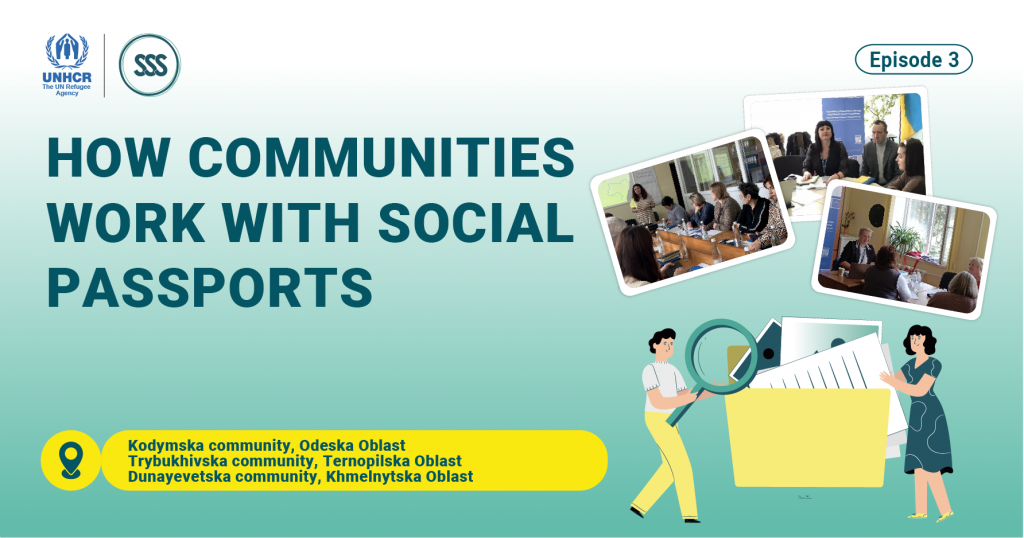
In the third installment of our special project (the first episode, the second episode), we highlight changes in the lives of three communities in the Odeska, Ternopilska, and Khmelnytska oblasts that were implemented after updating their social passports.
Our Support for the Communities in 2023–2024
- Studied the accessibility and quality of social services available in the communities.
- Conducted workshops for social system workers and local authorities on compiling social passports.
- Updated and designed social passports.
- Helped develop medium-term plans for the development of the social protection system.
A social passport is an identity document containing information about the community’s resources and social characteristics that enables an assessment of the community’s potential.
Experience of the Kodymska Community
Results achieved by communities after research and development of the documents:
- A department of social and psychological support was established within the structure of the Center for the Provision of Social Services.
- A medium-term development plan for the social protection system was approved, including new programs to support IDPs and expand services.
- A hotline (helpline) was established to provide prompt support in crisis situations, making social and psychological services more accessible.
- New partners were found to implement and expand social services, including social support programs.
- The budget includes expenditures for the procurement of social services from third-party providers to improve their quality and diversity.
Liudmyla Simashkevych, Director of the Center for the Provision of Social Services of the Kodyma City Council:
“Coordinated and timely cooperation has helped us provide better social services. During our work, we encountered many legal questions. Thanks to our collaboration, we were able to receive qualified answers. It is reassuring that in any uncommon situations, we have the opportunity to turn to you and receive a competent professional response and recommendation.”
Experience of the Trybukhivska Community
Results achieved by communities after research and development of the documents:
- Developed the Strategy for the Development of the Social Protection System of the Trybukhivska Territorial Community for 2024–2026.
- Created official Facebook pages: Social Services in the Trybukhivska Community and Children’s Affairs Service of the Trybukhivtsi Village Council.
- Introduced a waiting list for IDPs in need of housing from temporary accommodation housing stock.
- Established the An Hour for Ukraine NGO for the collective protection of the rights and interests of community residents, particularly displaced children, children from military families, and volunteering children.
Yana Shkuratova, regional coordinator of the project:
“Internally displaced persons regularly arrive in the Trybukhivska community, as a spacious Collective Center with comfortable living conditions has been established here. However, the community does not yet have a temporary accommodation housing stock, despite already allocating land plots and premises that could be provided for IDPs as temporary housing. Since such a register did not exist, we made this issue one of the priorities for cooperation in 2024. We now have an executive committee decision to introduce this register, along with personnel responsible for its maintenance.”
Anzhelika Mishchanchuk, Director of the Center for the Provision of Social Services of the Trybukhivtsi Village Council:
“The participation of the Trybukhivska community in the project throughout 2024 has helped address a number of issues in the social sector, identified through a sociological study on the accessibility and quality of social and administrative services in the community, conducted by the CO “Charity Foundation “Stabilization Support Services” and has allowed us to focus more on informing residents about social services and opportunities for receving them.”
Experience of the Dunayevetska Community
Results achieved by communities after research and development of the documents:
- Launched a mental health recovery project — provision of a set of social services (The Resilience Center).
- Organized remote workstations for the ASC (Administrative Services Center) administrators.
- Reorganized the work of social service professionals and specialists in social protection departments.
- Reviewed the salaries of social service providers, considering proper material and living conditions and increasing the profession’s prestige.
- Under consideration is the establishment of a Volunteer and Charity Council to ensure clear coordination of efforts between the authorities, social protection institutions, charitable organizations, volunteers, and those in need of assistance.
Olena Otrubchak, Director of the Lastivka City Center for Comprehensive Rehabilitation of Persons with Disabilities:
“The community’s social passport became the decisive argument for including the community in the experimental project of the Ministry of Social Policy of Ukraine, within the framework of which, a comprehensive set of social services for resilience-building will be implemented. The project became an example of public-private partnership, helping to involve non-governmental organizations in the provision of social services with the possibility of funding. It has also opened up prospects for forming a system of social contracting, aimed at ensuring and improving the living conditions of specific social groups and individuals in the Dunayevetska community.”
63 social passports we helped update in 2023–2024: bit.ly/4ggkSi5.
This publication was prepared by the Charity Foundation “Stabilization Support Services” with funding from UNHCR, the UN Refugee Agency in Ukraine. The content of this publication is the sole responsibility of the CO CF SSS and cannot be used to reflect the views of the Agency.
The information is current as of January 14, 2025.