
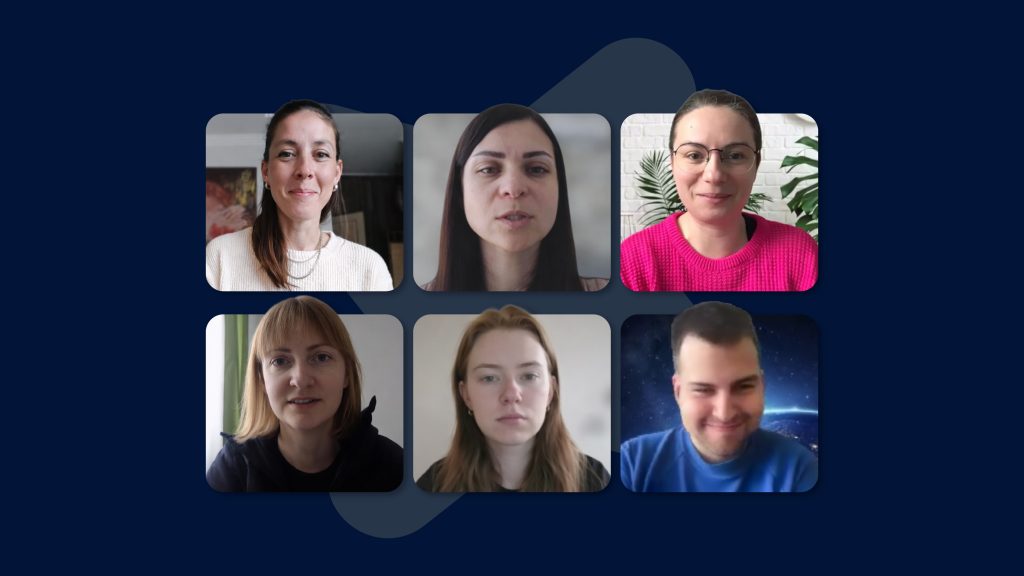
Work on planning a democratic future continues: participants of the Democratize the Future program once again gathered at the Digital Laboratory. Teams continued working on four cases, fictional but rooted in real Ukrainian contexts: creating inclusive urban spaces, involving youth in decision-making at the level of local self-government, ensuring digital services are accessible for the elderly, and integrating internally displaced persons (IDPs) into communities.
Since one of the cases focused specifically on IDP integration, the discussion invited expert Oksana Savytska, advisor to the Stabilization Support Services Foundation on the development of IDP Councils. She explained how formal rules often lag behind people’s real needs, and why this must be considered in future planning.
After this, young leaders moved on to practical work with the Three Horizons methodology. This is a strategic thinking tool that shows change as a sequential process:
- Horizon 1 (Present): what has already become the norm, even if that norm does not work well.
- Horizon 2 (Transition): new approaches and ideas that are emerging but not yet established.
- Horizon 3 (Future): the vision of a desired future that can become reality.
The teams’ task was to define: what should be protected, what should be let go, and what needs support.
“The methodology helped us see our case not just as a set of tasks, but as a strategic path. It gives a clear understanding of where we are now and where we want to move,” shared a participant from Zaporizhzhia.
The program is implemented by the Stabilization Support Services Foundation in partnership with MAD Foundation (Sweden), with financial support from the Swedish Institute (Svenska institutet).