
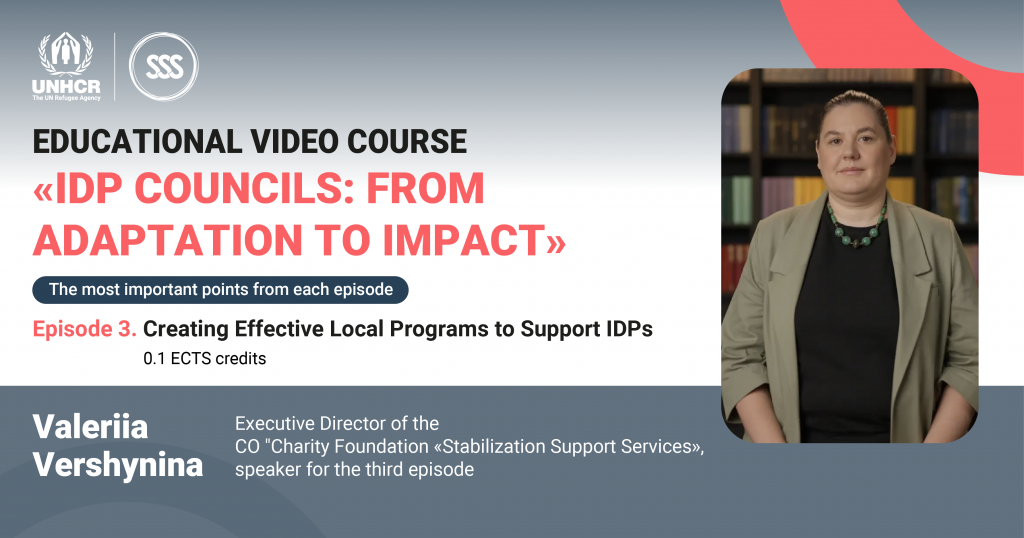
How can you create a local IDP support program that truly works? Where should you start with its development? What types of programs exist, and what should be considered at each stage? Who should monitor the effectiveness of adopted local programs, and how? You will find the answers in the third episode of our training video course, “IDP Councils: From Adaptation to Impact” — “Creating Effective Local Programs to Support IDPs.”
Valeriia Vershynina, Executive Director of the CO “Charity Foundation “Stabilization Support Services,” speaker for the third episode:
“If you want your community to effectively support displaced persons, don’t miss the third episode. This is a step-by-step guide for those who aim to create effective IDP support programs in their community. Here, you will learn about the legal foundations of the process, the stages of program development, and ways to collaborate effectively with local authorities to improve the lives of displaced persons.”
We have compiled the key information from the episode into a brief summary. Watch the training video course, read the key points in text format, and save the info cards on social media: Facebook and Instagram.
All who complete the course will receive 0.1 ECTS credits*.
*The European Credit Transfer and Accumulation System, or ECTS, is a tool developed by the European Union to ensure the compatibility of higher education systems in different countries.
Summary of the Episode “Creating Effective Local Programs to Support IDPs”
Legal Regulation
Territorial communities have the right to approve local socio-economic development programs**.
** Constitution of Ukraine (Art. 143), Law of Ukraine “On Local Self-Government” (Art. 26, 27).
*Resolution of the CMU No. 812 dated August 4, 2023.
Please note! Such programs can be initiated not only by local councils but also by non-governmental organizations and even residents of the communities.
Powers of IDP Councils
IDP Councils can draft local programs to support displaced persons’ businesses and provide methodological and advisory assistance in developing programs for the public sector, providing housing for IDPs, etc.
To implement joint projects, IDP Councils can collaborate with:
- Local self-government bodies;
- Non-governmental organizations;
- Businesses;
- International humanitarian organizations;
- Volunteers, etc**.
Types of IDP Support Programs
Territorial communities can adopt various programs to support displaced persons, for example:
- Housing provision programs;
- Employment support programs;
- Small business and self-employment support programs;
- Social protection programs;
- Psychological support programs;
- Integration programs;
- Medical assistance programs;
- Legal support programs.
Please note! These programs should be comprehensive and consider various aspects of integration, depending on the community’s needs and budget capabilities.
Preparation and Stages of Program Development
Before starting to prepare a draft, it is important to familiarize yourself with the territorial community’s regulations and other legal acts to clearly understand the program approval procedure and the requirements for drafts.
Key Stages of Program Development
First stage — initiating and defining the problem. At this stage, the needs of displaced persons in the community should be identified.
Second stage — developing the program concept and discussing it with stakeholders.
Third stage — preparing the draft program, which undergoes expert review and approval.
Fourth stage — approving the program at a session of the local council and including it in the annual community development plans.
Implementation Planning and Monitoring
After the program is approved, it is important to develop a clear plan for its implementation: specify concrete tasks, deadlines, and those responsible for implementation.
Monitoring the program’s execution allows for the timely identification of problems and the introduction of necessary adjustments. Evaluating the results allows for the adjustment and implementation of necessary changes to improve the program’s effectiveness.
Please note! The IDP Council can play a key role in this process by providing feedback from the community.
Want to learn more about how to influence local policy and improve the lives of IDPs? Take the video course “IDP Councils: From Adaptation to Impact” on the Diia.Education platform.
The training course (educational series) was created by the Charity Foundation “Stabilization Support Services” with the financial support of UNHCR, the UN Refugee Agency in Ukraine, for the Diia.Education platform.
This publication was made with the support of UNHCR, the UN Refugee Agency in Ukraine. The content of the publication is the sole responsibility of the Charitable Organization “Charity Foundation “Stabilization Support Services” and does not reflect the views of UNHCR.