
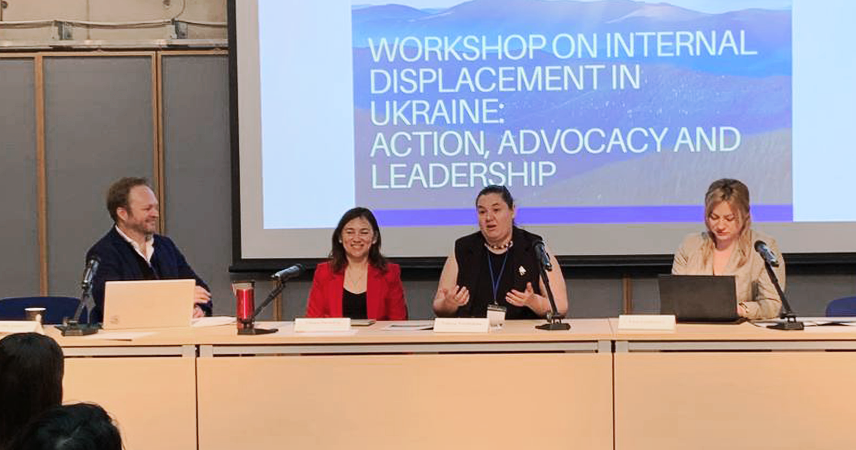
Last week, Warsaw hosted the International Workshop on Internal Displacement in Ukraine: Action, Advocacy & Leadership. The event brought together researchers, experts, representatives of civil society organizations, and leaders of IDP Councils from Ukraine and other countries. The team from the Charity Foundation “Stabilization Support Services” took an active part in the workshop, presenting Ukrainian expertise on the work of IDP Councils.
Over two days, participants discussed how Ukraine’s experience can transform global approaches to integrating internally displaced persons and strengthen their influence on local politics.
Valeriia Vershynina, Executive Director of Stabilization Support Services, gave a presentation on Ukraine’s lessons for global contexts of internal displacement.
“The Ukrainian model of IDP participation did not emerge as a pre-designed ‘ideal system’. It was developed through a combination of several important factors: decentralization, an active civil society, women’s leadership in social issues, and the availability of digital registries. In times of extreme turbulence, the most important discipline is not expansion, but prioritization,” Valeriia Vershynina emphasized.
Special attention was paid to the role of IDP Councils as consultative and advisory bodies within communities, the use of data for local policy planning, and the gradual transition of humanitarian aid into long-term solutions through inclusive governance.
“IDP councils demonstrate that people who have experienced displacement can be leaders who bring their own expertise to the community and offer sustainable solutions. Ukraine’s experience with multiple and cross-border displacement creates opportunities to bring together the knowledge, networks, and experiences of Ukrainians from different countries, strengthening inclusive recovery and democratic resilience,” said Olha Ivanova, Director for Development and Advocacy Programs.
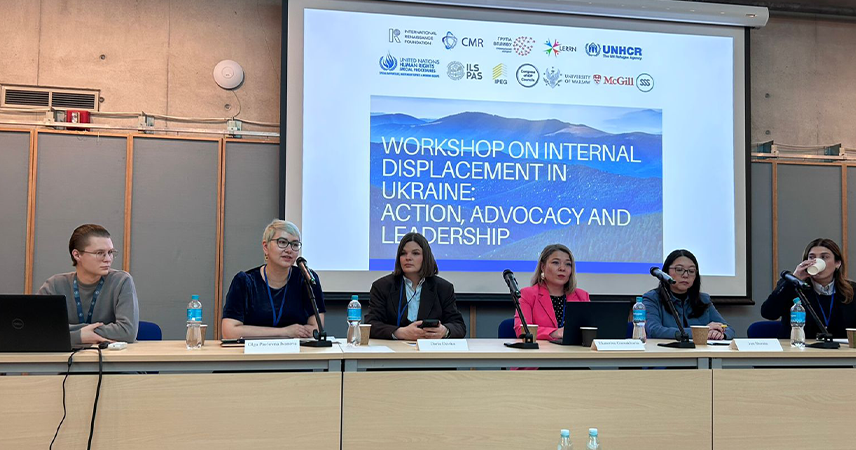
At the same time, participants noted that communities have very different opportunities—from large cities to small settlements—and although they have all been affected by the war, their experiences in this process will vary significantly. That is why IDP participation at the local level varies: in some places, it becomes a real tool for influencing decision-making, while in others it remains limited due to a lack of resources.
“Ukrainian IDP Councils are now reaching the international level — they are becoming part of the global dialogue on internal displacement, sharing their own experiences and at the same time learning from colleagues from other countries. This means that the experience of Ukrainian IDPs is no longer just about survival, but about leadership, partnership, and influencing international approaches to finding sustainable solutions,” said Oksana Savytska, Advisor on IDP Council Development.
“IDP Councils have proven to be an effective mechanism for integration. They should be viewed as a strategic resource for the country’s post-war recovery, provided they have a real mandate, resources, and access to decision-making. This event provided an opportunity to present Ukraine’s experience of institutionalising IDP leadership at the international level and compare it with global practices for responding to internal displacement,” said Anastasiia Perepelytsia, Chair of the IDP Council under the Zaporizka Oblast State Administration.
“It was especially valuable to meet and exchange practices with colleagues from Georgia and Colombia, countries that have also gone through a difficult period of internal displacement. Such international connections give us the opportunity not to repeat the mistakes of others in creating IDP support programs, to implement proven tools, and, at the same tim,e adapt them to the Ukrainian context. This opens up new horizons for the reconstruction and recovery of Ukraine, taking into account the best international practices and focusing on dignity, self-reliance, and the integration of people,” emphasized Oleksandra Basan, Chair of the IDP Council under the Pidhorodne City Council.
As emphasized by the discussion participants, IDP participation is not a separate project but part of the institutional infrastructure that requires clarity, accountability, and an understanding of one’s own capabilities.
The Stabilization Support Services team’s participation in this event was an important part of the international dialogue on the role of internally displaced persons as partners in policy-making, recovery, and community development.
This workshop is supported by the Social Sciences and Humanities Research Council of Canada (SSHRC), the University of Warsaw, the Local Engagement Refugee Research Network (LERRN), the Fonds de recherche du Québec – Société et culture (FRQSC), OHCHR, UNHCR, the International Renaissance Foundation, the McGill Institute for the Study of International Development (ISID), and the Research Group on Global Justice of the Yan Lin Centre at McGill University.