
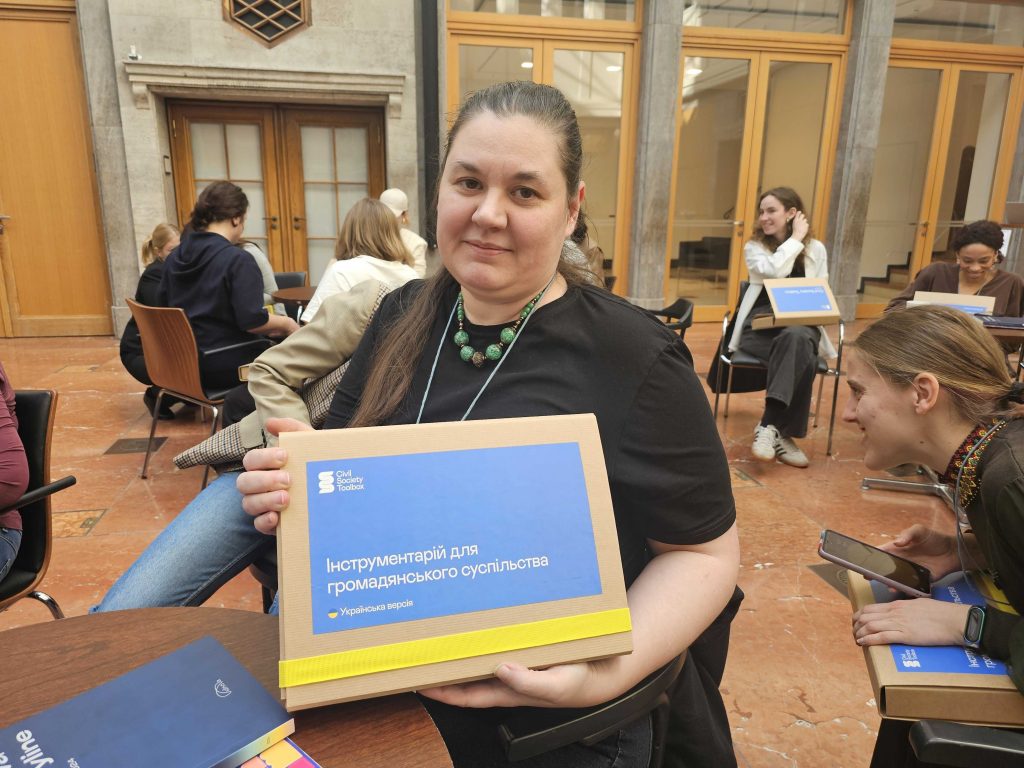
Over several days, our Executive Director, Valeriia Vershynina, participated in key events in Berlin dedicated to Ukraine’s recovery and the role of civil society in this process.
Ukrainian Civil Society Organizations: Resilience in Action
During the panel discussion Status and Conditions of Ukrainian NGOs in Ukraine and Germany, Valeriia spoke about the current status of civil society in Ukraine, the challenges organizations face, and their adaptation to new conditions. She placed particular emphasis on the impact of funding cuts from the United States and the strategic approaches that enable the civil society sector to continue its work.
“When discussing the status of the civil society sector in Ukraine, we cannot ignore the cessation of U.S. funding. However, this is far from the first such crisis in Ukraine. Organizations that have been operating for a long time remember the exodus of partners in 2022 and the suspension of projects during COVID-19. Unfortunately, similar events occur in our country with a certain regularity, and we must account for these risks.
Each organization currently facing a funding halt must work in three directions simultaneously — minimizing risks for the affected population, its own team, and the organization as a whole. In this situation, cooperation with new donors can be both a lifeline and a death sentence. In times of financial crisis, organizations cannot accept projects that do not ensure fair wages, proper safety protocols, and administrative expenses. Such cooperation only depletes resources and kills initiatives; it is also imperative not to take on projects that do not include provisions for legal support and tax payments, as this significantly increases risks for organizations.”
Valeriia urged partners not to offer Ukrainian organizations partnerships on terms they themselves would not accept. She also shared the Foundation’s experience in creating financial security mechanisms, finding alternative resources, and establishing responsible partnerships.
Strategic Discussion: From URC 2024 to URC 2025 – Lessons Learned and the Status Quo
A significant part of the discussion focused on the role of the global Ukrainian community and diaspora in Ukraine’s recovery and strengthening connections between Ukrainians worldwide. Valeriia shared the CO SSS’s experience in engaging IDP Councils in dialogue with forcibly displaced Ukrainians. She called on international partners to involve Ukrainian communities more actively in reconstruction processes.
The key message was that IDP Councils must be integrated into international platforms where decisions about Ukraine’s future are made.
“We talk about rebuilding, but do we really listen to those who have experienced forced migration? IDP Councils must not just be witnesses but participants in these processes.
Last year, our Foundation made significant efforts at all levels to ensure the inclusion of IDP Councils in URC 2024. However, unfortunately, not a single IDP Council representative was included in this discussion. Our task now is to correct this mistake and ensure their presence at URC 2025.”
The Foundation stresses the necessity of the direct participation of IDP Council representatives in the Ukraine Recovery Conference (URC 2025), as their experience is unique and critically important for the effective integration of IDPs into local communities.
Networking at Café Kyiv
Ukrainian civil society is not just about decisions — it is, first and foremost, about people.
At Café Kyiv, Valeriia had the opportunity to speak with international partners and representatives of the civil society sector, discussing challenges and prospects for cooperation.
“We build coalitions because we understand that no single organization can overcome these challenges alone. Ukrainians, no matter where they live, remain part of our community and allies in the fight against Russian occupation. We must seize every opportunity to support each other and act together to help Ukraine.”
The Foundation continues its work to strengthen civil society’s role in Ukraine’s recovery. We are grateful to all partners for their support and willingness to listen to the voices of those who are directly working toward change.
“The work of the civil society sector in Ukraine today is a daily struggle for survival, balancing between reality and donor expectations. It is a battle not only for funding but also for retaining professional teams and maintaining people’s trust.
And this discussion is not just about challenges. It is about what civil society should be to not just survive, but to develop — even under the most difficult conditions,” Valeriia emphasized.
In her speech, Valeriia highlighted the key problems Ukrainian NGOs face and the ways to overcome them.
Localization and Compliance with Ukrainian Legislation
The Ukrainian context has its own unique features, including a complex and extensive legal framework and a high level of regulation. We often encounter donor attempts to impose international experiences or practices that are not adapted to this level of a rule-of-law state.
Grant applications or proposals that prohibit tax payments or social protection for teams must disappear forever. Instead, every partnership should begin with respect for Ukrainian organizations and national legislation.
“We cannot afford to implement mechanisms that do not work in our reality. We must not only maintain operational efficiency but also protect our employees and organizations from legal and financial risks.”
Practicality and Critical Approach to Outdated Models
Many organizations attempt to implement the same approaches that worked ten years ago without critically reassessing them, turning civil society work into a cargo cult. Unfortunately, in conditions of extreme exhaustion of both resources and people, these decisions are not just ineffective — they kill local initiatives.
“We must always ask ourselves — why are we doing this? How can we achieve the same result in an easier way? Where is the golden mean between productivity and its cost? We must be sure that our activities truly benefit people.”
Valeriia also addressed questions regarding the consequences of reduced American funding for Ukrainian NGOs. She shared the experience of the CO SSS:
- The Foundation covered debts caused by funding cuts using its own resources, depleting administrative reserves.
- A decision was made to temporarily suspend all organizational development initiatives to avoid jeopardizing key programs.
- The Foundation seeks additional funding exclusively from international sources to avoid competing with military initiatives within Ukraine.
“The funding cuts are not just about money — it’s about the stability of thousands of people working in this sector. Today, every Ukrainian organization must find a balance between saving its own teams and retaining the ability to continue to help others.”