
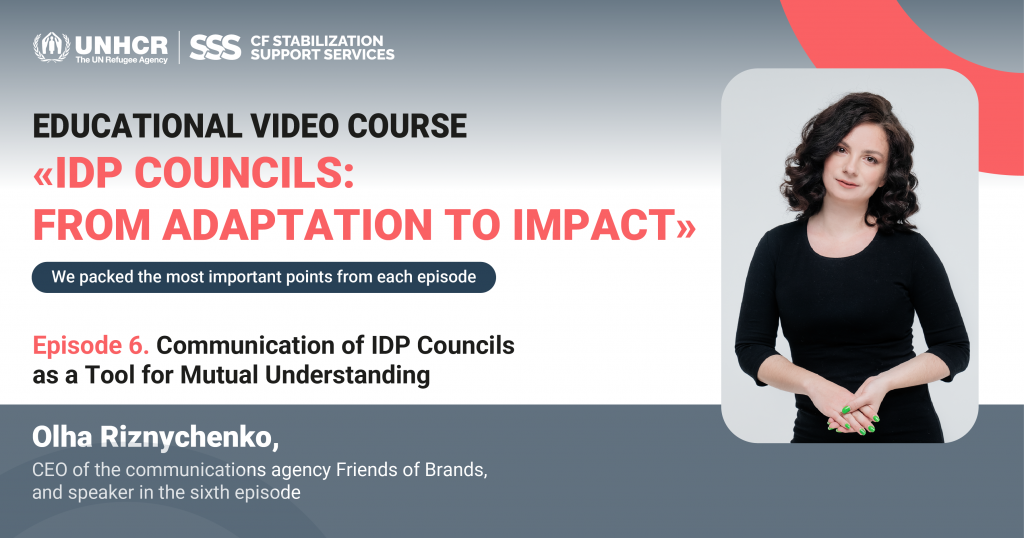
What does effective communication require? Why is it important to be gender-sensitive? What methods help avoid communication conflicts? You’ll find answers to these and other questions in the sixth episode of our educational video course “IDP Councils: From Adaptation to Impact.”
You’ll find the answers in the sixth episode of our video training course “IDP Councils: From Adaptation to Impact” — “Communication of IDP Councils as a Tool for Mutual Understanding.”
Olha Riznychenko, CEO of the communications agency Friends of Brands, and speaker in the sixth episode:
“Effective communication is the foundation of successful IDP Council work. It helps streamline internal processes, build trust with the community and authorities, and make your work visible. The knowledge you gain will help you analyze your current communication and identify areas for improvement.”
We have compiled the key information from the episode into a brief summary. Watch the training video course, read the key points in text format, and save the info cards on social media: Facebook and Instagram.
All who complete the course will receive 0.1 ECTS credits*.
*The European Credit Transfer and Accumulation System, or ECTS, is a tool developed by the European Union to ensure the compatibility of higher education systems in different countries.
Summary of the “Communication of IDP Councils as a Tool for Mutual Understanding” Episode
What is communication, and why is it important for IDP Councils?
For IDP Councils as public bodies, communication is a daily necessity. You will be expected to provide commentary on news and changes in legislation affecting internally displaced persons, official responses, statistics, proposals for various strategies and programs, participation in expert and public discussions, posts about achievements on social media, and reporting.
Effective communication helps you make yourself heard and achieve your goals.
Internal communication
Internal communication refers to discussions and the exchange of information within the IDP Council itself.
It is important to agree on who is responsible for what within the team.
The chairperson of the Council is supposed to:
- Set up information-sharing processes within the Council.
- Set tasks in line with the strategy.
- Monitor their implementation.
The secretary of the IDP Council is responsible for various aspects of formal communication, including documents, letters, and minutes.
It is important to communicate with your team respectfully, even when there are differences of opinion. After all, you share a common goal, and together you can achieve more.
External communication
External communication involves engaging with the displaced community, ministries, government agencies, community members interested in its development and social cohesion, experts, international and Ukrainian non-governmental organizations, the business sector, academics, journalists, bloggers, working groups, and others.
For IDP Councils, external communication is part of transparency and accountability.
Gender sensitivity in communication
Effective communication must be gender-sensitive.
Gender sensitivity is the ability to recognize gender differences, gender-based discrimination, and manifestations of inequality, and to take these aspects into account in strategies and actions.
We recommend using feminine forms when writing or speaking about female colleagues or women in other contexts.
Your communication should be inclusive, showing respect for people’s diversity.
Nonviolent communication
Nonviolent communication is based on understanding yourself and others by clarifying facts, observations, feelings, and needs. This does not mean accepting unacceptable conditions or agreeing with someone just to avoid an argument. Nonviolent communication is about caring and about your needs.
Networking
Networking includes social media groups, work-related chat rooms that bring together Council members from different regions, and various forums and conferences where you can meet new colleagues and exchange experiences with them.
Want to learn more about how to influence local policy and improve the lives of IDPs? Take the video course “IDP Councils: From Adaptation to Impact” on the Diia.Education platform.
The training course (educational series) was created by the Charity Foundation “Stabilization Support Services” with the financial support of UNHCR, the UN Refugee Agency in Ukraine, for the Diia.Education platform.
This publication was made with the support of UNHCR, the UN Refugee Agency in Ukraine. The content of the publication is the sole responsibility of the Charitable Organization “Charity Foundation “Stabilization Support Services” and does not reflect the views of UNHCR.