
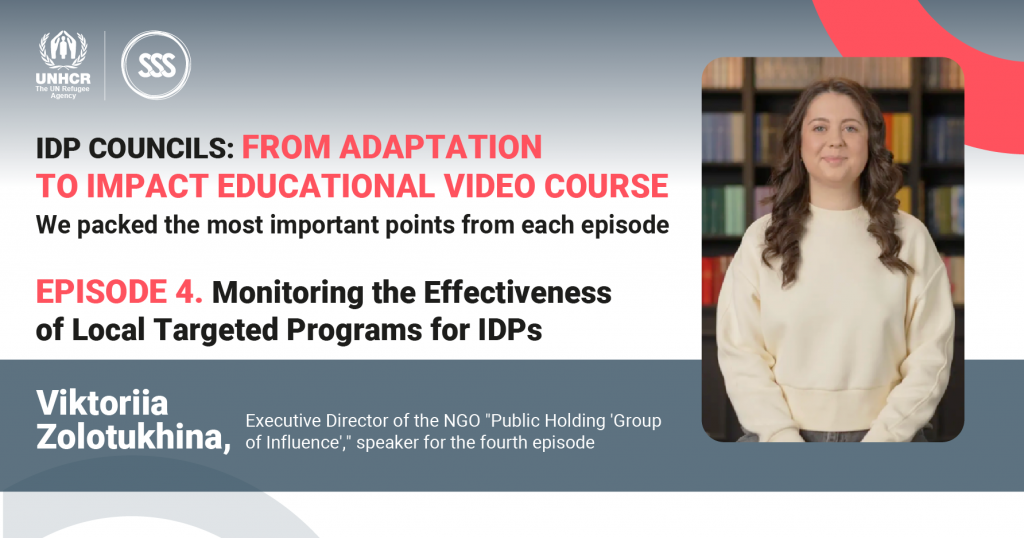
What is the monitoring of local targeted programs, and why is it important? Where to begin? How should information be collected, and what should be included in the report? You will find the answers in the fourth episode of our educational video course IDP Councils: From Adaptation to Impact — Monitoring the Effectiveness of Local Targeted Programs for IDPs.
Viktoriia Zolotukhina, Executive Director of the NGO “Public Holding ‘Group of Influence’,” speaker for the fourth episode
“This video episode is designed to show that monitoring is not a formality, but a real tool for improving the quality of local programs. We talk about how communities and IDP Councils can influence the transparency, efficiency, and effectiveness of decisions that directly change people’s lives.”
We have compiled the key information from the episode into a brief summary. Watch the educational video course, read the main points in text format, and save the infographics on social media: Facebook and Instagram.
All who complete the course will receive 0.1 ECTS credits*.
*The European Credit Transfer and Accumulation System, or ECTS, is a tool developed by the European Union for the compatibility of higher education systems in different countries.
Summary of the Episode “Monitoring the Effectiveness of Local Targeted Programs for IDPs”
Monitoring of local targeted programs
Monitoring is the continuous or periodic collection and analysis of information to assess the effectiveness of a specific task or program. The main goal is to determine how successfully programs are being implemented and resources are being used, and whether the planned results have been achieved.
Monitoring and evaluation of the effectiveness of local targeted programs should be conducted at all stages of their implementation — from planning and creation to completion. This approach ensures transparency and accountability and improves the quality of future initiatives’ planning and execution.
Planning the monitoring
The organization of monitoring and evaluation takes place in stages.
The first stage is planning: we define tasks, performance indicators, information collection methods, and a schedule.
The second stage is data collection on the implementation of program activities and the use of resources.
The third stage is the analysis of the collected data to assess the effectiveness of the program’s implementation.
The fourth stage is the preparation of a report with recommendations.
Performance indicators
Each targeted program must have performance indicators that correspond to its goals and objectives.
All indicators can be divided into three levels:
- Output indicators (help to assess quantity and quality)
- Outcome indicators (help to assess the extent to which the program has achieved its planned goals and results, focusing on changes)
- Impact indicators (help to assess the long-term results and changes that have occurred as a result of the program’s implementation)
Please note! Indicators should not be too many; they must be clear and understandable, and the information for them must be accessible for collection.
Data collection methods and tools
- Identify the sources of information for each indicator.
IDP Councils, in accordance with the Model Regulation, have the right to receive necessary information and documents from executive authorities, local self-government bodies, enterprises, institutions, and organizations. - Determine the best methods for collecting and analyzing information. This could include document content analysis, surveys and polling, focus group research, in-depth and expert interviews, case study analysis, etc.
Analysis and reporting
The monitoring results are formalized in a report that includes:
- A description of the methodology
- The collected data
- Data analysis
- Recommendations.
Please note! This report should not be viewed as a formality, but rather as a means of improving programs and informing the community.
Do you want to learn more about how to influence local policy and improve the lives of IDPs? Take the video course IDP Councils: From Adaptation to Impact on the Diia.Education platform.
The educational video course (educational series) was created by the Charity Foundation “Stabilization Support Services” with the financial support of UNHCR, the UN Refugee Agency in Ukraine, for the Diia.Education platform.
This publication was prepared with the support of UNHCR, the UN Refugee Agency in Ukraine. The content of this publication is the sole responsibility of the Charity Foundation “Stabilization Support Services” and in no way reflects the views of UNHCR.