
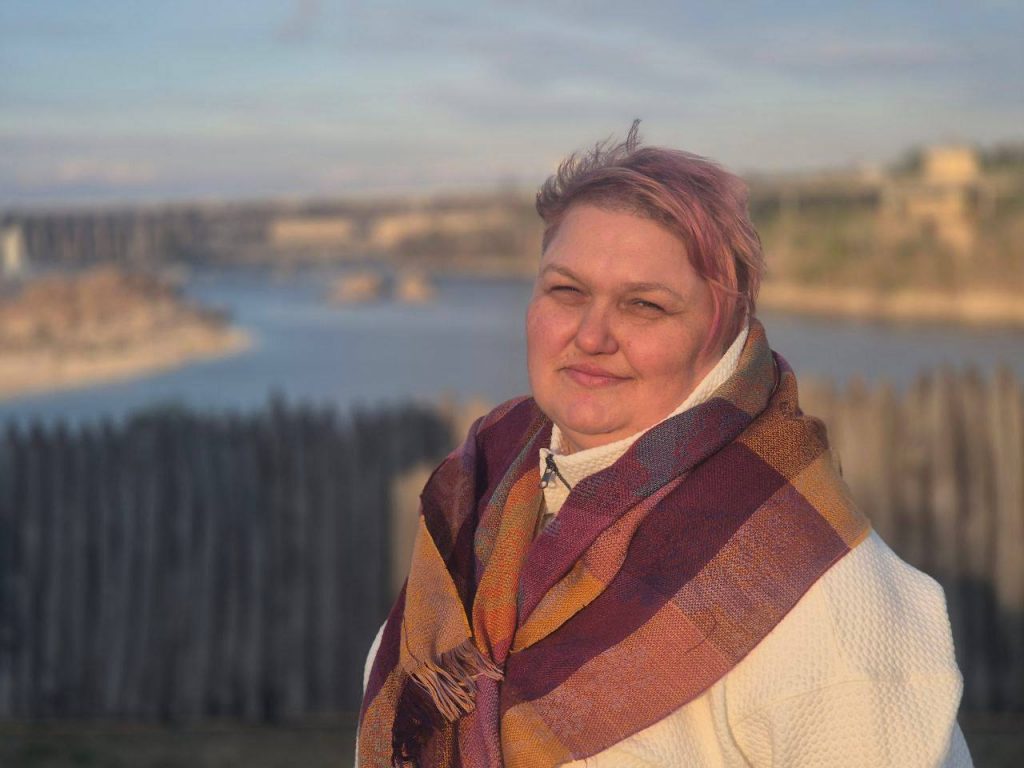
Oksana Levada, the regional coordinator for the Zaporizhzhia region at the CF SSS, has been with the Foundation for over a year. Prior to this, she was an active volunteer, and from the first days of the full-scale invasion, she prepared to defend her city and help evacuees.
In this interview, Oksana shares how her work at the Foundation is changing the lives of people in Zaporizhzhia and discusses what kind of assistance the city still needs.
- Oksana, what led to your work at the Charity Foundation “Stabilization Support Services”?
Before the full-scale invasion, I worked for a construction company for a time. But after February 24, 2022, a new chapter of my life began. I live on the outskirts of Zaporizhzhia, so in the early days of the war, I joined others in preparing to resist the enemy: the locals filled sandbags, built barricades, set up fortifications, and even welded anti-tank hedgehogs right on the streets… I could not just sit idly by. Staying home, in the relative safety of my house, was scarier than working alongside everyone else.
By March, people from the occupied territories started arriving in Zaporizhzhia. There were so many that I felt the need to join a group of volunteers who were helping to receive and house the displaced.
At the time, I thought I had seen all the possible suffering people could go through — but I was very wrong. The worst came later when people started arriving from occupied Mariupol. It is hard even to recall those battered cars, hungry people, and children without parents who had simply been put into a car to save them.
I heard hundreds of horrifying stories that chilled me to the bone. According to the people from Mariupol who managed to escape, the enemy would let one convoy of people pass but then open fire on another. We really did receive the wounded. Unfortunately, not everyone made it…
- Did you ever consider leaving for a safer region or going abroad yourself?
Zaporizhzhia is my hometown, and I was prepared to defend it in any way I could. I never even thought about leaving my home. I want to go through everything together with my city. And now, working with the Foundation, I can help it even more than before.
- Let us talk about your work at the Foundation in more detail. What do you enjoy most about it?
I’ll start by saying that I joined the CF SSS team by chance. In March 2023, I learned about an engineer vacancy and decided to apply because I felt the potential and already had some volunteer experience. I went through all the necessary stages, and they offered me the position of regional coordinator. Now I realize that nothing happens by accident. The Foundation is a place where, as a woman, I have no limitations in my professional development. It is a big, friendly family of like-minded people where everyone’s opinion is respected, and we work together to implement important projects.
- What is the most challenging aspect of your work? You and your regional team work in frontline communities where air raid alerts are a daily occurrence, and you visit areas where the risk of shelling is very high. How do you manage to achieve your goals under such conditions?
Despite the daily threats and frequent explosions, everything in Zaporizhzhia continues to function. We Ukrainians are adaptable people; we have learned to live and work between air raid alarms. I understand my mission at work — to help those who are in far more difficult situations than I am. Yes, sometimes it is scary, and that is a completely normal reaction for a healthy person. But it is even more terrifying to think that everything we’re doing could suddenly stop. And we ca not afford to stop because displaced people are still arriving in Zaporizhzhia. Imagine for a moment: people travel from the occupied territories to Russia, then to Belarus, then to Poland, and finally reach Ukraine, here in Zaporizhzhia, just to be near their still-occupied homes. When I hear their stories and see how their lives have been shattered, I know that we have to roll up our sleeves and work even harder…
- You and your team are currently working on the project Provision of Lifesaving Winterization, NFI, and Shelter Support to Conflict Affected Populations in Ukraine (NIN). In your opinion, what makes this project so important?
Due to the frequent airstrikes, many institutions in Zaporizhzhia have suffered significant damage. The city authorities cannot handle these large-scale challenges and destruction on their own. This project is designed to help where it is needed the most. We are repairing temporary housing for displaced people, clinics, and social institutions.
We are installing windows in buildings where over 2,000 people come for social services each month. We’re restoring doctors’ offices to provide parents and children with comfortable conditions for their medical examinations. Some institutions, by the way, we have already repaired.
- What projects are missing in Zaporizhzhia, given the current situation? How do you see the people’s needs?
Our city is near the front line, so living conditions here are harsh, especially for displaced people. Of course, our Foundation is already doing a lot to support them in every way possible: we are repairing facilities where they live, distributing humanitarian aid, and providing financial assistance. But the city itself also needs attention and support from donors. I think we need more projects like NIN, which are not only focused on individual assistance but also cover various areas and reach a large number of people.
- Oksana, your team knows you as an optimistic person who is always smiling, joking, and in good spirits. How do you manage to stay positive in such difficult circumstances?
During this full-scale war, we have all undergone personal transformations: we do not react as sharply to some things anymore, and we reassess many aspects of life. Every day in these wartime conditions is incredibly valuable — waking up healthy in the morning is already a huge blessing, something to be happy about. And a smile and good mood are also our weapons, showing our resilience!
This publication was prepared as part of the Provision of Lifesaving Winterization, NFI, and Shelter Support to Conflict Affected Populations in Ukraine project, implemented by the Charity Foundation “Stabilization Support Services” in partnership with the international humanitarian organization CARE and with support from NACHBAR IN NOT.