
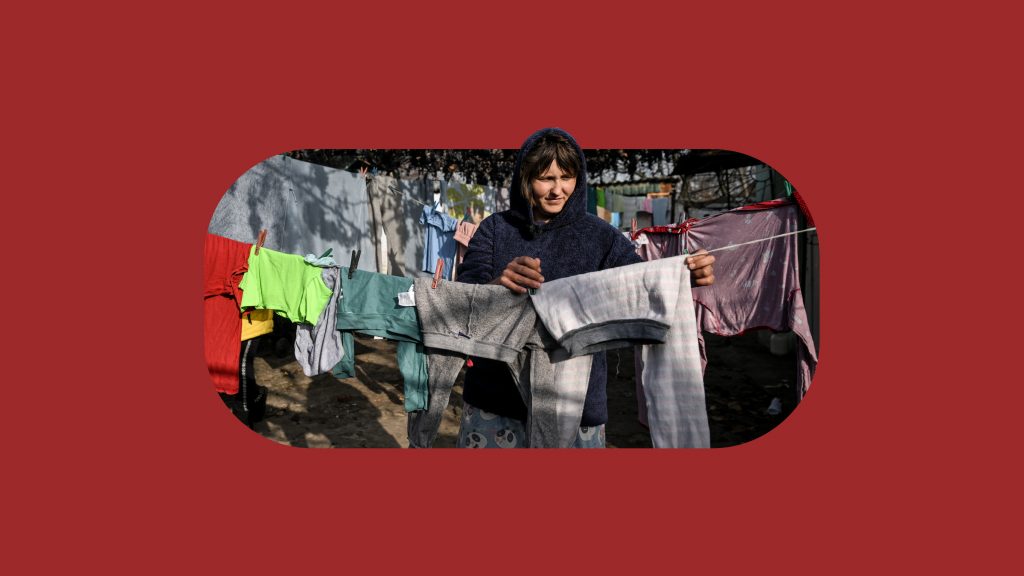
With the scent of flowers and a sense of true cleanliness, Ms. Olena hangs freshly laundered clothes in her yard. She brought them from a mobile laundry service that came to work in their village in the Mykolaiv region today.
“This time I brought a lot of clothes. I need to wash winter jackets and pants, and there’s a lot of children’s underwear. We collected two whole bags. On my own, it would take me more than a day to wash all this, but the assistants will wash everything in just two hours. The weather outside is nice and sunny, so I won’t wait for the clothes to dry; I’ll hang them out in the yard, and they should be dry by evening,”— the woman says.
Ms. Olena is an internally displaced person. Ms. Olena’s family moved to the Mykolaiv region at the start of the full-scale war. The village council gave them an empty house that the previous owners had abandoned. The house is small, but it’s their own and it’s warm. The woman is raising seven children. Her youngest daughter is just over six months old.
“I’m a mother of many children. So cooking and doing laundry are things I do every day, and there’s never less of them. While the older children are at school, I try to get the meals ready so that when they come home, lunch and dinner are waiting. There is no drinking water in the village at all. It’s delivered to us in large canisters, and we fill up bottles and carry them home. So, to make borscht and porridge for the kids, I have to go get water first. Laundry is much harder. There is no centralized water supply in the village; there are only wells. The water there is murky and salty. To do the laundry, I carry water from the well during the day—about 10 buckets—and let it settle until evening. Then, at night, when the kids go to sleep, I heat the water in pots and start doing all the laundry. I’ll admit, it’s really hard. The kids never sit still; they’re always getting dirty, so we never run out of laundry,” — the woman says.
According to the woman, she was very lucky, as the previous owners had left an old washing machine in the house. It still works, at least occasionally. However, starting in the fall, due to constant power outages, she had to wash everything by hand. For the woman’s family, the mobile laundry unit has, without exaggeration, been a true lifesaver. Every time it comes to the village, it’s an opportunity not only to wash clothes properly but also to take a shower.
“I don’t know who came up with the idea to create a mobile laundry unit, but I’ll never stop thanking you for its work. You can’t even imagine how much you’re helping me. Laundry has always been the hardest chore for me. Because of the constant hard work, my hands had already started to go numb; I couldn’t even hold my child. Now it’s become much easier. I know I’m not alone and that I’ll get help. If something is really needed, I wash it right away; I don’t wait for the mobile unit. But if the clothes aren’t seasonal and aren’t urgently needed for tomorrow, we save them until the mobile unit arrives. In the summer, we even went there to shower. A wonderful warm shower. They provide everything we need for free on-site. While the clothes were washing, we’d take a quick shower, and then we’d all go home happy. Now we’re waiting for warmer weather so we can go take a shower again. It’s such a joy when the kids are clean and their clothes are fresh and smell nice. I see smiles on the children’s faces. Thank you for taking care of us. We couldn’t have managed without you,” — says Ms. Olena, with tears in her eyes.
In the de-occupied and frontline communities of the Mykolaiv and Kherson regions, mobile laundry and shower facilities have been in operation for nearly a year. During this time, 24,000 people have used the laundry services, and more than 6,000 residents of these regions have been able to take a hot shower. All services are provided free of charge.
The mobile complex operates as part of a project implemented by the charitable organization Stabilization Support Services Charitable Foundation and the German humanitarian organization Sign of Hope with financial support from the German Federal Foreign Office (GFFO).