
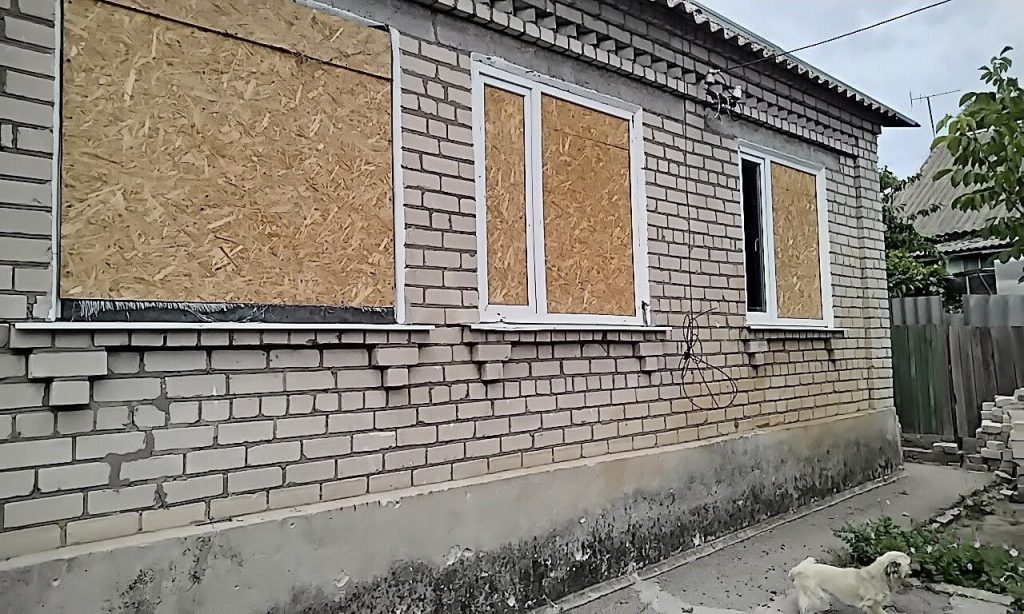
How does the Foundation select households for repairs? Why might a household be denied repairs? What documents are needed? What types of repairs do we perform, and which ones do we not? Is there a financial limit on repairs for a single family? Our team has begun the repair phase of the Providing Multi-Sectoral Humanitarian Assistance to Conflict-Affected Populations in Ukraine project and is receiving many similar questions. In this article, we will provide answers.
- Where can I register for repairs of war-damaged housing?
Check the communication channels of your local authorities—they usually publish information about all available humanitarian aid options.
We prepare announcements with the conditions for providing such assistance and an online registration form, which we then pass on to local authorities. These authorities post the announcements and links to the registration form through their communication channels with local residents. For example, in Kherson, such announcements are posted on the Telegram channel and the website of the city’s military administration. The local authorities provide us with lists of households affected by the war and heads of homeowner associations (OSBB) with whom we communicate further and from whom we receive lists of those most in need of assistance (owners of damaged housing who still live in it, people with disabilities, large families, elderly individuals over 70, and other vulnerable categories). All this data is also included in the online registration form.
- Why didn’t I receive a call after registering?
Your home may not be located within the community defined by the project, or there might be a severe security situation in your area.
The Foundation processes completed forms and initially selects them based on territorial criteria. For instance, if we announce repairs in Kherson, we only accept applications from there. Additionally, we assess which areas of the city are under constant shelling and exclude those, focusing on relatively safer areas where our team can work in less dangerous circumstances. Unfortunately, this does not include parts of the Korabelnyi and Dniprovskyi districts of Kherson.
- Why was I contacted but then denied assistance?
You may currently live far from your home and cannot sign the agreement and certificate with us, or you lack the necessary documents.
During phone conversations with those who meet the territorial criteria, we ensure that the homeowners currently reside in their homes and have the required documents to sign a contract with us—a document proving ownership and a document confirming that the property was damaged due to the war after February 24, 2022. If these documents are not available or if the owners are currently far from their homes, we cannot provide assistance. We are required to sign the contract for repairs and the completion certificate only with the owners. Relatives or registered residents cannot do this in their place.
- Why was I denied repairs even after being contacted and visited?
You may not have had the necessary documents, or the required repairs are either too complex or considered cosmetic and internal.
First, during the initial visit to each pre-selected household, we request the owners to present documents that confirm ownership of the property by those who applied to us (not their deceased relatives or those who do not currently reside at this address) and documents that confirm the damage to the property occurred due to the war after February 24, 2022. If these documents are not available and cannot be quickly obtained (explained how to in our article), unfortunately, we must refuse assistance.
Second, we conduct a preliminary assessment of the required repair work and only undertake light repairs. The goal is to prepare the household for winter, insulating and protecting the living space from moisture. We cannot repair severely damaged structural elements, such as broken or destroyed walls or a significant portion of the roof. We also do not perform internal and cosmetic repairs (damaged ceilings, flooring, furniture) or repair balconies.
If the property has significant damage (e.g., the building’s structural integrity is compromised due to a direct hit, causing the house to tilt, or the roof beams are broken, or the ceiling has collapsed), we do not perform even partial repairs (such as window replacement) because such a situation requires much more extensive repairs than we can provide within this project.
- Why am I only offered partial repairs instead of a full restoration?
The total cost of all necessary repairs exceeds $1,200.
Under this project, we can repair one household for a maximum amount of $1,200. If the cost of repairing all the damage to your home exceeds this amount, we can offer to perform only part of the necessary work, staying within the maximum allowable limit.
- Do I have to pay for anything?
No, all repair work is carried out free of charge.
If you have any questions or encounter any difficulties, you can contact us by filling out a form on our website, and we will respond as soon as possible.
In conclusion
Within the scope of this project, we only carry out light, non-cosmetic, and non-internal repairs for residents of Kherson and the Shevchenkivska community in Mykolaivska Oblast. When selecting households, we consider the security situation, the availability of necessary documents, the presence of the owners, and vulnerability criteria. We process all completed forms, and the security situation and the vulnerability categories of the applicant or their family members are crucial in our evaluation. If we find that any information is missing during our analysis of the submitted online forms, we will definitely contact the person who filled out the form.
Currently, there are 4,800 damaged households registered in Kherson, but within the scope of this project, we can only carry out 350 repairs. Therefore, unfortunately, we cannot provide repairs for everyone who requests them through this project alone. Be sure to follow the social media channels of your local authorities for information on other humanitarian aid opportunities, as most humanitarian organizations collaborate with them.
The project Providing Multi-Sectoral Humanitarian Assistance to Conflict-Affected Populations in Ukraine is implemented by the Charitable Organization “Charity Foundation “Stabilization Support Services” in collaboration with the humanitarian organization CARE Ukraine and the Ukraine Response Consortium. The program is funded by USAID’s Bureau for Humanitarian Assistance (BHA).