
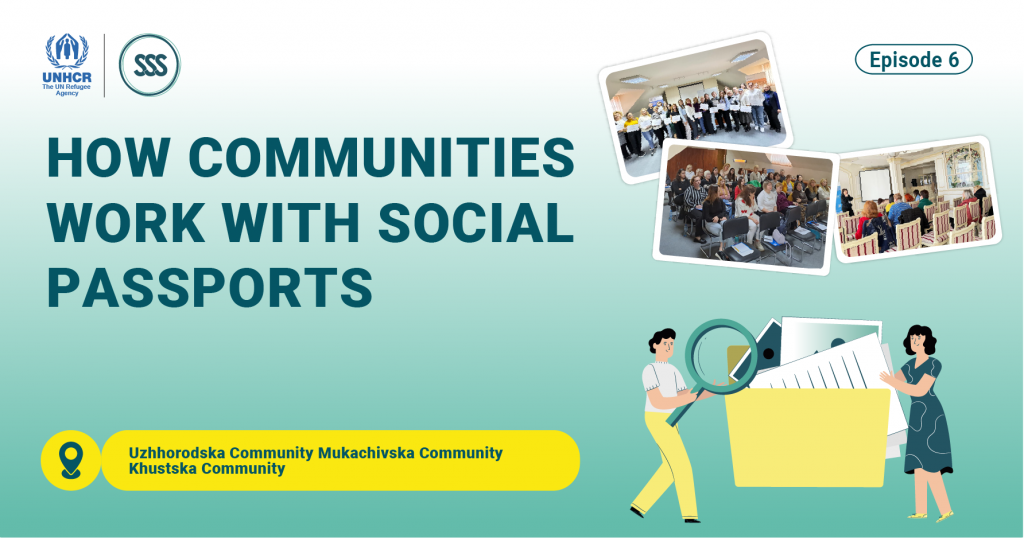
How do communities improve social services with social passports?
To ensure that social services meet people’s needs, communities must clearly understand their challenges, recognize their own resources, and know how to attract additional support from donors and investors. The social passport helps communities structure this information, define key areas for developing the social protection system, and engage potential partners in joint efforts.
In 2023–2024, we assisted communities in creating social passports, trained local specialists, and supported the development of medium-term plans for improving social protection systems in communities.
In this sixth and final installment of the special project, we present the results achieved by the Mukachivska, Uzhhorodska, and Khustska communities of Zakarpatska Oblast as they worked with social passports and development plans for their social protection systems.
A social passport is a key tool for assessing a community’s resources and social characteristics, enabling better planning of services and social programs for its residents.
The Experience of the Uzhhorodska Community
Results achieved by the community after research and development of the documents:
- Conducted training for specialists in inclusive education to improve diagnostic, correctional, and socialization methods for children with special educational needs.
- Expanded collaboration between social services, local authorities, and non-governmental organizations to address pressing social challenges and ensure an adequate level of services for IDPs.
- Prepared a request and developed regulatory documents for implementing the Social Taxi service for people with limited mobility and IDPs.
Alisa Lokhmachova, inclusive education coach:
“Global trends focused on integrating children with special educational needs into society are being used to develop and enhance diagnostic, correctional, and socialization methods — so that inclusive and special education is not a luxury but a reality. However, we have noticed that not only children need support but also teachers. We are here to dispel myths and support educators. We will help them see opportunities, find strength and resources to understand the child, and create a comfortable living environment.”
The Experience of the Mukachivska Community
Results achieved by the community after research and development of the documents:
- Organized a roundtable discussion on the Accessibility of Social Services in the Mukachevo City Territorial Community, where key challenges and opportunities for improving the social protection system were discussed.
- Proposed the introduction of a Social Taxi service to ensure transport accessibility for people with limited mobility and IDPs.
Lyudmyla Bandurchak, acting head of the Social Protection Department of the Mukachevo City Council:
“During the roundtable, we discussed current issues related to trends and challenges in the community’s social protection sphere. The challenge for us is implementing new, relevant services. Among the proposals considered was the purchase of a specialized vehicle for the Social Taxi service.”
The Experience of the Khustska Community
Results achieved by the community after research and development of the documents:
- Conducted an awareness campaign on available social services, increasing knowledge among residents and IDPs, particularly in remote villages.
- Prepared and submitted a request for the implementation of the Social Taxi service for people with limited mobility and IDPs.
- Improved coordination between local authorities, social services, and NGOs to better address the needs of IDPs and vulnerable populations.
- Introduced mechanisms to enhance the accessibility of social services, including visualizing information for elderly people.
Vasyl Kalyn, Deputy Mayor of Khust:
“Step by step, we are increasing awareness about social services in our community’s remote villages. Our social protection system helps people, and does a lot, especially for IDPs, but often lacks the time to communicate about it. In the age of information technology, this is critically important. However, some people (such as pensioners) are accustomed to perceiving information visually — and they are among the main recipients of these services. That’s why the booklet we received through our cooperation with the CO CF SSS is extremely valuable.”
You can take a look at the social passports we helped create here: bit.ly/4ggkSi5
This publication was made with the support of UNHCR, the UN Refugee Agency in Ukraine. The content of the publication is the sole responsibility of the Charitable Organization “Charity Foundation “Stabilization Support Services” and does not reflect the views of UNHCR.
The information is current as of March 10, 2025.