
What is the demographic situation in the community? What social services are provided? How developed are small and medium-sized businesses? Are there enough schools, hospitals, and banks? The answers to these questions are important for both the community and investors, as they allow them to assess its potential. A social passport, a document containing information about a community’s resources and social characteristics, can tell you everything.
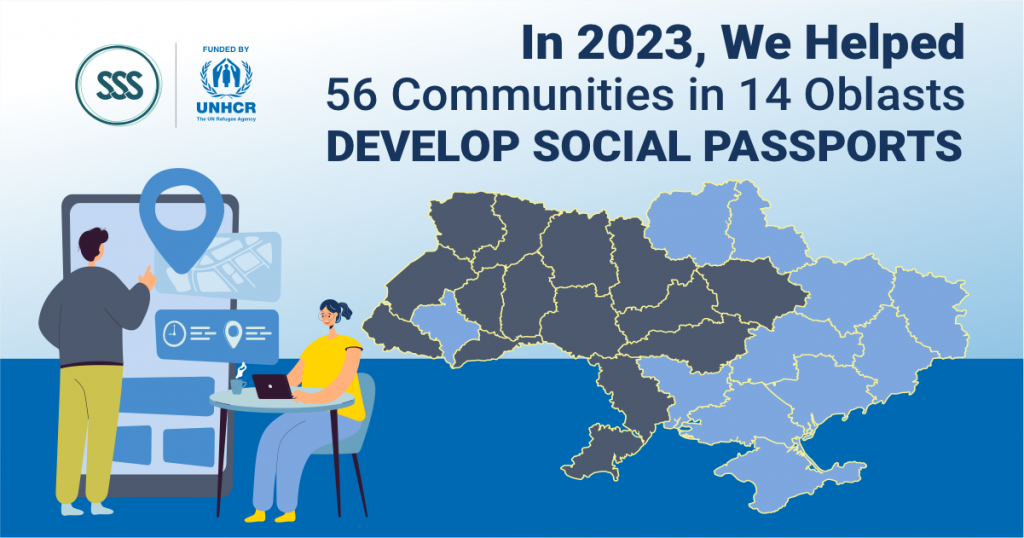
Last year, our Foundation provided regular assistance to the target communities in drawing up or updating their social passports. We also conducted an assessment of their social service needs, as the full-scale war in the country has increased the number of people in need of social support and protection. We cooperated with 56 communities in 14 oblasts: Vinnytska, Volynska, Zhytomyrska, Zakarpatska, Kyivska, Kirovohradska, Lvivska, Odeska, Poltavska, Rivnenska, Ternopilska, Khmelnytska, Cherkaska and Chernivetska. Our regional teams provided methodological and advisory support to 4 communities in each oblast.
The work performed in the communities will affect the quality of life of almost 3 million people living in them, including more than 300,000 internally displaced persons.
What the communities accomplished with our support:
- 56 social passports that we have designed (all documents are available on our website);
- medium-term plans for the development of the social protection system based on our research on the accessibility and quality of social and administrative services.
Yuliana Hasanbekova, the Foundation’s coordinator for the development of social passports, explains more about working with communities and the impact of social passports on their development.
On the capacity of local authorities to provide social services:
“Ukraine has completed the decentralization reform. A significant part of the powers to ensure the provision of social and administrative services, minimum living standards, development of welfare, and barrier-free accessibility are now vested in territorial communities. As a result, all communities are experiencing an additional burden and are forced to look for their own capabilities and resources to meet the needs of the population. The full-scale military invasion of Ukraine by the Russian Federation complicates these tasks significantly. Therefore, the project’s main goal is to strengthen local authorities’ capacity to provide services to citizens.”
On cooperation with communities:
“The work in the communities began with the creation of working groups to develop social passports and assess the needs for social services. The next step was to hold training events in the communities on developing social passports, assessing social service needs, and planning the development of the social protection system in the target communities. We held open workshops in each target community at the first meetings of the working groups. This helped build strong communication and partnerships and ensure 100% involvement in the process.”
On the content of the social passport:
“The communities were directly involved in filling in the social passports with the support of our regional teams. The documents contain the most up-to-date information about the community, taking into account the situation in all settlements: the number of population and households, gender composition, management structure, public utilities, and enterprises, starosta districts, accessibility of pharmacies, banks, medical facilities, schools, and kindergartens, institutions providing administrative and social services, transportation between settlements and the administrative center of the community.”
On the functions of a social passport:
“The concisely presented information allows us to get to know the community quickly and thoroughly. At the same time, this data helps the community to make management decisions on the efficient use of available resources and attract additional investments.”
On assessing the need for social services:
“We also conducted a comprehensive sociological study on the availability and quality of social and administrative services in the target communities. This study took into account the opinions of both recipients and providers of such services. This provided a description of the social reality in the community and identified its strengths and weaknesses in this area.
The assessment of service needs in the communities we conducted formed the basis for the creation of medium-term plans for the development of the social protection system, as well as measures to ensure the availability and quality of social services in the community.”
On supporting target communities in 2024:
“We will continue to support communities in this regard. The project will include advocacy activities to implement the new plans for the development of the social protection system.”
We support communities in preparing social passports within the framework of the Supporting the Capacity of the Social Protection System to Register Internally Displaced Persons project funded by the UN Refugee Agency in Ukraine.