
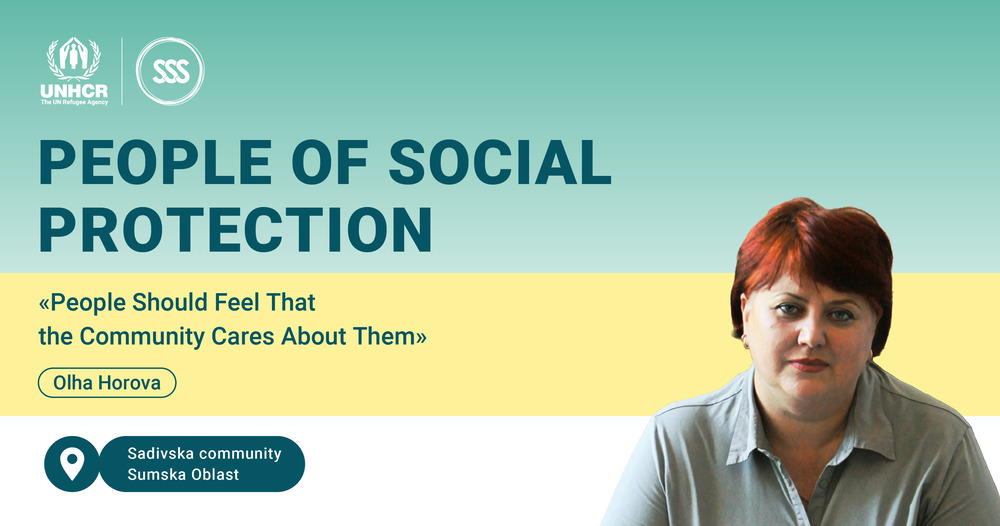
Olha Horova is the second interviewee in our annual People of Social Protection project, where we discuss the work of social protection institutions in various regions of Ukraine. Since 2021, Olha has been the head of the Sad Village Council Social Services Center in Sumska Oblast (the Center).
The Sadivska community in Sumska Oblast comprises one settlement and 32 villages, with a population of approximately 12,000 people, including 1,369 internally displaced persons (among whom are 340 children), who primarily come from border and temporarily occupied territories, or from areas of active or potential hostilities.
“Since the start of the full-scale invasion, we have been providing free social services to all vulnerable groups of the population in difficult life circumstances, although the Law on Social Services requires otherwise. This decision was made at the first session after the start of the full-scale war,” says Olha Horova. Despite the danger posed by the Russian invasion in 2022, the institution’s employees continued to work without interruption.
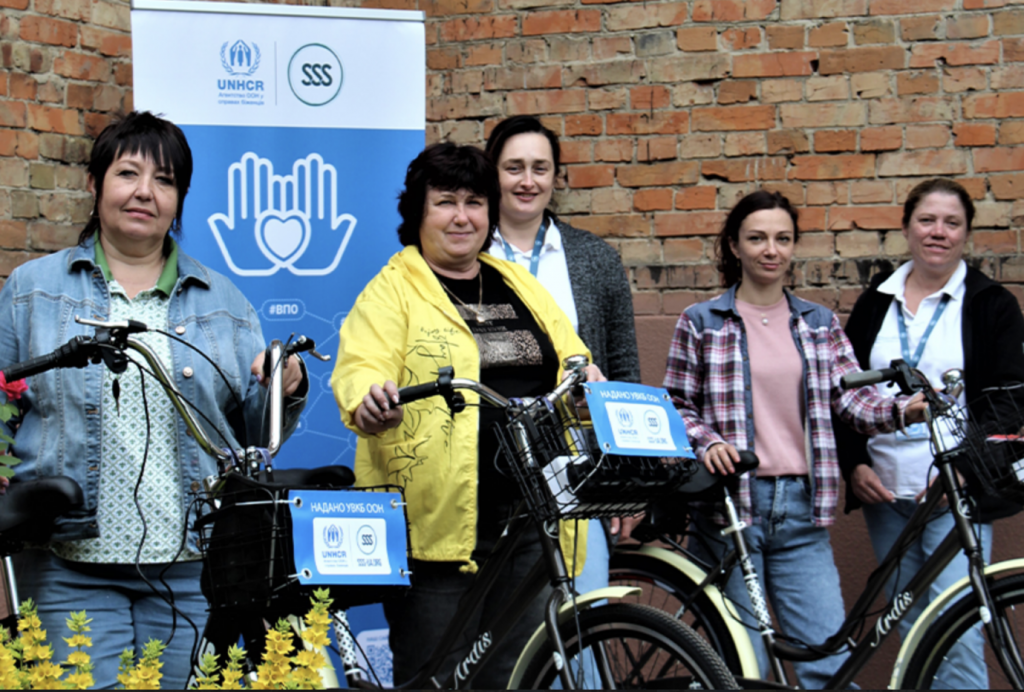
The Center has four departments with different social focus areas, including a home care department. This year, with the support of UNHCR, the UN Refugee Agency in Ukraine, we donated three electric bicycles (one tricycle and two bicycles) to the institution. Thanks to these bikes, social workers can get to their clients who are in tough situations faster and give them all the help they need: buy groceries and medicine, prepare meals, clean the house, take care of sanitation and hygiene, tend to the garden, accompany them to medical facilities, pay for utilities, clear snow, bring coal or firewood and light the stove, or even represent their interests in government agencies.
In this interview with Olha Horova, we discussed the services provided by the Center, how its workload has changed during the war, why its opening was a success not only for the Sadivska community but also for the region, and the services the institution plans to develop in the coming year.
The Social Services Center
Olha, please tell us about the Sadivska community. How many displaced persons has it taken in?
The Sadivska community was established in late 2020 as part of a nationwide decentralization program, and our institution was registered in early 2021. At the beginning of 2025, the community had approximately 12,000 residents, including about 1,400 IDPs. There is no longer such an influx of IDPs as there was last year, for example, when border communities suffered from round-the-clock shelling and were being relentlessly ravaged. Due to active hostilities drawing closer, people are now mostly moving further away — to the central part of Sumska Oblast or to safer regions of Ukraine.
What are the key areas of work for the Social Services Center under your leadership? How long have you been in charge of it?
I have been working in this position since January 4, 2021. I started working in the social sector in 2016 as the chief accountant of the Territorial Center for Social Services of the Sumskyi Raion State Administration. After the decentralization of Sumskyi Raion, the center was dissolved, and I was invited to work in the Sadivska community.
The main task of our Center is to provide prompt and high-quality social/rehabilitation services to community members and internally displaced persons, families/children in difficult life circumstances, children and adults with disabilities, as well as to provide social and psychological support to war veterans and demobilized soldiers on a peer-to-peer basis, and to the families of deceased and missing defenders of Ukraine (both for local residents and IDPs).
The institution has four departments.
In the Department of Social Services at the Place of Residence and Provision of a Range of Social Services, we provide home care services to elderly people, single people, and people with disabilities. In 2025, 186 people will receive this service on a permanent basis.
The Department of Comprehensive Rehabilitation for Children and Adults with Disabilities conducts remedial and developmental work, provides psychosocial support and physical rehabilitation services (exercise therapy, adaptive massage, etc.). It offers hippotherapy sessions, a gym, a sensory room, and an art therapy room. Before the full-scale invasion, we served about 30 children, including through co-financing, from other communities in Sumskyi Raion, as rehabilitation services are not available everywhere in the oblast. At the beginning of the war, many children were evacuated from the oblast. Currently, the department serves 17 children and adults with disabilities.
Specialists from the Department of Social Work provide social support to individuals and families who find themselves in difficult life circumstances, as well as to family-type orphanages and families of guardians and caregivers. In 2025, 31 families (including two family-type orphanages) in difficult life circumstances used the social services provided by this department. That is 114 people. In addition, specialists from the Department of Social Work assessed the needs of 187 families whose children had applied for the status of children affected by war and armed conflict. Last year, we worked hard to assess all their needs. According to the results of the assessment, approximately 1,800 children received this status.
In addition, the Department of Social Work provides support to victims of domestic violence. In 2025, we assessed the needs of 20 families where the fact of domestic violence was confirmed. All these families were provided with psychological support, legal advice, and other types of social services.
One of the new activities in the context of full-scale war is the Service Office for Veterans. Since March 2024, it has been offering an accessible and safe space for comprehensive support to demobilized soldiers, military personnel, and their families, as well as the families of fallen defenders of Ukraine (both for local residents and internally displaced persons). The office provides advice on social guarantees and benefits, helps with paperwork, and provides psychosocial support. The Service Office’s specialists help anyone who wants to resolve complex life issues, including the transition from military service to civilian life. Currently, the office employs a leading specialist in supporting war veterans and demobilized soldiers, as well as a therapist.
We also have a social laundry, which was established thanks to the Charity Foundation “Stabilization Support Services” in the spring of 2025. Community residents and IDPs can wash their clothes there free of charge. The institution also has a rental station with about 200 units of rehabilitation equipment, which anyone can rent if needed.
We continue to work closely with charitable and civil society foundations and international donors to receive charitable/humanitarian aid. Power supply devices help to ensure the uninterrupted operation of the institution without electricity. We also received office equipment and supplies, professional laundry equipment and detergents, household supplies, hygiene and food kits, and solid fuel.
How many people work at your center? How has their workload changed during the war?
The center has a staff of 26 people, including 15 social workers. The actual average workload per social worker in 2025 is 11 clients, while the legally approved norm is 6 in rural areas and 10 in urban areas. Working directly with people is always difficult. Such work requires energy, emotional and physical effort, and tolerance, because all clients have different health problems, and due to their advanced age or disability, each has their own life and work experience and their own approaches to running a household. The war has worsened our mental state; people are exhausted, frightened by the occupation and constant shelling, and irritable. All this causes an exacerbation of chronic age-related diseases. Many people need not only physical but also mental help and support. Some social workers come back after their visits and say, “I have an old lady who has a two-hour visit scheduled. I come to help her with the housework, to do what we have planned together, but sometimes she just wants to talk quietly, to receive some initial psychological support, to be listened to, to feel sympathy in order to stabilize her emotional state. After all, a simple conversation brings joy, peace, and reduces loneliness.”
Since 2022, we have been providing free services to everyone who comes to us, even though the Law of Ukraine “On Social Services” requires otherwise. This decision was made at the first session after the start of the full-scale war. Those who need support cannot be left without help, so some social workers serve up to 15 people.
Support for IDPs
How many IDPs does the Center serve? What are their main needs?
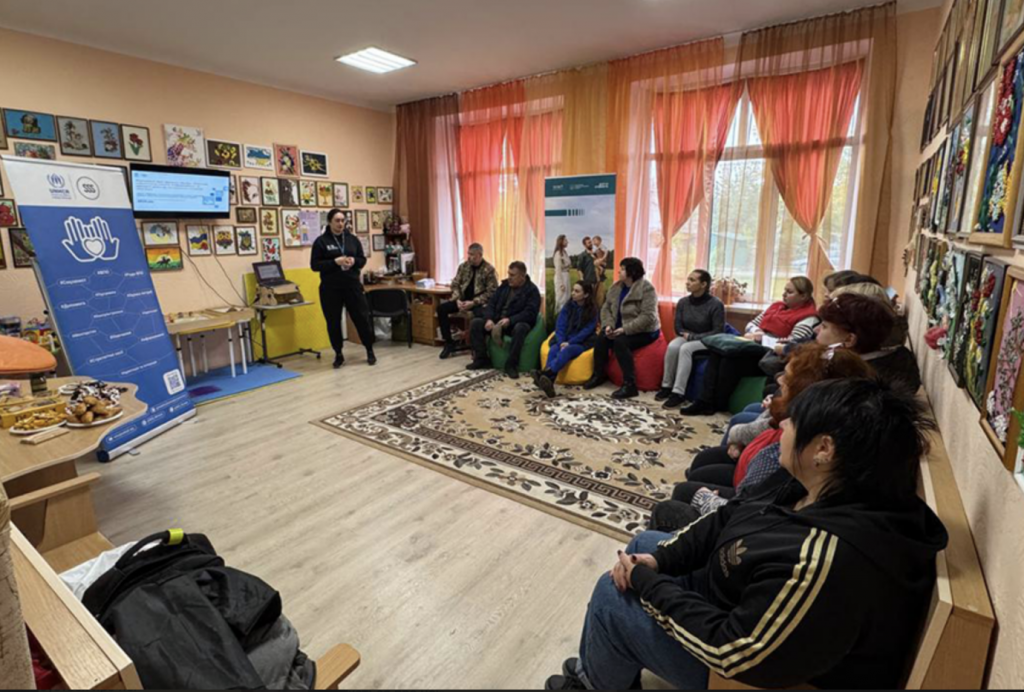
We do not have many IDPs applying to us for services, only 29, because we can only provide services to those who have reached retirement age or have a disability. At our institution, they receive home care, social and mental health support, and, if necessary, our specialists help them apply for various types of assistance, recover lost documents, provide assistance and support in applying for disability status, help find temporary housing, and refer them to humanitarian and charitable organizations to receive clothing, shoes, and food packages, because there are some clients from the border area who fled the shelling almost barefeet… The institution employs a therapist who assists anyone in need of social adaptation, psychological, and psychosocial support. We also collaborate with charitable foundations and non-governmental organizations and engage their specialists to provide mental health and legal support and assistance.
The Needs of the Social Services Center
What have been the Center’s greatest achievements and challenges since the start of the full-scale invasion?
Overall, the greatest achievement was not only the opportunity to establish such an institution in our community, but also to assemble and, especially in such difficult times, maintain an incredibly strong and united team of professionals who not only organize and provide basic social services, but also constantly strive for development, and introducing innovative and experimental social/rehabilitation services to improve the well-being of our community. The Center was created to provide comprehensive assistance and support, and we have never refused to help anyone.
Even during the most difficult times for Sumska Oblast, from the first day of the full-scale invasion until the end of April 2022, the institution did not stop working even for a day. Under the threat of shelling, everyone performed their immediate duties with dignity and even courage, leaving none of their wards without care and support, while, of course, following safety measures. Some villages were effectively occupied, but we did not abandon them. We cooperated with the oblast administration, which provided humanitarian food packages, as nothing could be delivered to stores. Our wards’ pensions are small, they have no food stocks, they didn’t even have enough to bake bread, let alone pancakes. Therefore, we organized and delivered everything we could 24/7, sometimes even our own stocks and preserves.
Our main achievement is the opening of a social laundry thanks to your Foundation. We renovated the old laundry room, installed two industrial washing machines, two industrial dryers with extractors, furnished the laundry workers’ workplace, and organized a place for visitors (we brought a wardrobe, a table, a sofa, and chairs). Now the washing process is much faster. The machine takes an hour at most to wash and up to an hour to dry. If an old woman wants to come herself, in an hour and a half or two she will wash everything, chat, relax, and take her dry clothes home. Some people do not have a washing machine at home, and some are no longer healthy enough to wash by hand. We do not refuse anyone and serve everyone who wants to use our services, so the laundry is in high demand.
This year, our Foundation, together with UNHCR, donated electric bicycles to the Center. How does this assistance facilitate your work?
Most of the community’s settlements are very spread out. There are large villages with long streets and scattered farmsteads located three to five kilometers from the village center. The electric bicycles provided by donors help us cover this distance quickly, for which we are very grateful.
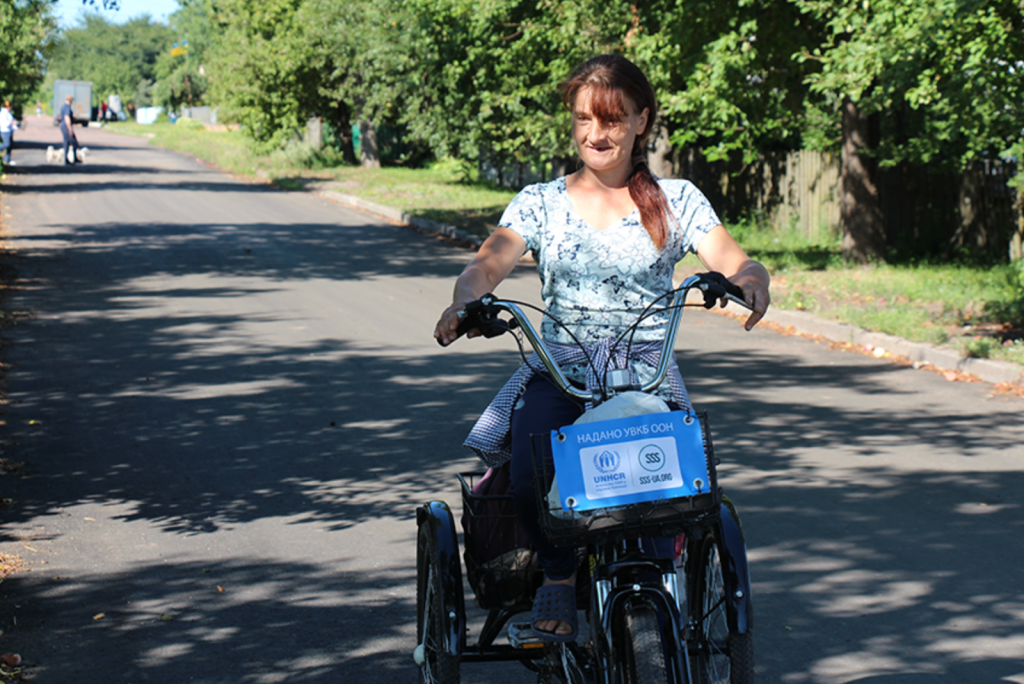
For example, we have a social worker, Olha Sema, who did not know how to ride a two-wheeled bicycle at all. They bought a three-wheeled electric bike just for her. She’s small and skinny, but she has a lot of people to look after, and they live far apart. Olha says, “I charge it, and it lasts me three or four days. Now I’m on top of the world. I put my bags in the basket and off I go.”
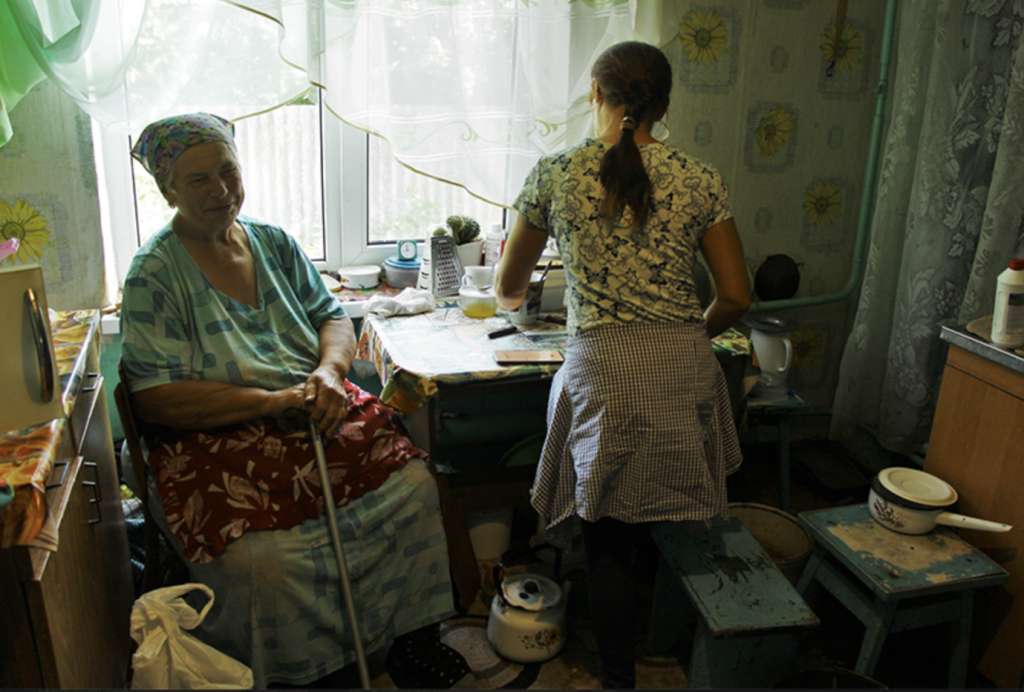
The elderly women under our care are also very grateful, because now we can get to them faster and, if necessary, visit them urgently to provide assistance or bring medicine. Incidentally, if the house has stove heating, social workers are responsible for occupational safety and people’s lives: they make sure that old people or families do not suffocate. They check on their clients by phone every day to make sure that everything is fine, especially during the heating season.
What else could improve the work of the Social Services Center?
We very much need a special vehicle to transport people with limited mobility who use wheelchairs or have musculoskeletal disorders. We have a GAZelle, a special vehicle with a lift for wheelchairs. But it is a Russian-made vehicle, manufactured in 2006 or 2007, and finding spare parts for it is a big problem. We repair it ourselves, but it needs major repairs: replacement of the engine and body, because it is completely rotten… In addition, the GAZelle is a tall vehicle. Nowadays, there are vehicles with ramps that can carry a person in a wheelchair. There have been cases when an elevator broke down and we had to carry people in wheelchairs into the car. We calculated that it would be easier to add 200 thousand to the repair costs and buy a newer car. Currently, the community is ready to consider purchasing such a vehicle on a 50/50 co-financing basis, possibly a used one, but in good condition.
We have many needs. We don’t have a powerful generator. Currently, there are nine workstations in the center, plus lighting, plus a laundry room… The 2.6 kW generator provided to us by donors can only power two computers and one printer. We need four phones for consultations (because people call the personal numbers of specialists), a couple of tablets for organizing the field work of specialists from the Department of Comprehensive Rehabilitation for Children and Adults with Disabilities.
The gym needs routine repairs and new exercise equipment. For the rehabilitation of people with disabilities, we wanted to purchase an interactive floor for the sensory room. Such a mat creates a play space for the development of psychomotor skills, mobility and coordination, as well as mental stress relief.
Social Work
What are the main qualities of social protection specialists?
The most important thing is to have love in your heart. Love for people, love for your neighbor. Strive to be a helping hand. Among the most important qualities of social workers are humanity, decency, patience, and restraint, because we work with people and for people… Everyone needs to be listened to, and an approach must be found for each person in order to solve the problems of those in our care.
A person who has turned to us for help, or a person whose needs we have learned about ourselves, should feel real support. They should feel that they are not alone, not abandoned, that the community cares about them. We want everyone to know that there is an institution in the community that cares for such people and is always ready to help.
Plans for Next Year
Please tell us about the Social Services Center’s plans for 2026. What activities would you like to develop?
This is the kind of region we live in… we survive the day and thank God for that. But we never run out of ideas. We never stop making plans. We hope for the best and trust in the Armed Forces of Ukraine. We want to develop our Center, improve the quality of our services, and expand the range of services we offer.
Our plans include renovating the premises allocated to us for the Resilience Center. There, we will provide psychosocial support services as part of the All-Ukrainian Mental Health Program “How Are You?”, which is being implemented on the initiative of First Lady Olena Zelenska. Such premises must meet certain requirements: there must be at least four rooms, an inclusive bathroom, a room for mothers and children with a changing table, a shower cabin, etc. We want to renovate the old premises and continue to use it as an inclusive and veteran space.
I have many ideas. For example, we plan to build a pool for underwater traction and rehabilitation after surgery and injuries to reduce pain and spasticity, restore proper posture, strengthen the core muscle system, and improve the musculoskeletal system. In 2021, we applied for a grant, but we didn’t get it. We also plan to build houses for temporary accommodation for internally displaced persons and people living alone. There are elderly people living alone in the community who live in houses damaged by shelling. But this is a long and complicated bureaucratic process, which starts with the allocation of land and leads to the installation of temporary housing for two or three families, with electric heating and kitchen appliances. If necessary, people could stay there safely for at least some time while their damaged homes are being repaired, under the supervision of social workers and receiving appropriate support and assistance.
We support the social protection system through the Support to the Capacity of Government Institutions and Local Communities To Strengthen Social Protection Systems in Ukraine project, implemented with the support of UNHCR, the UN Refugee Agency in Ukraine.